Best Soil for Container Gardening: Easy Potting Mix Guide
Best Soil for Container Gardening: What to Use in Pots The best soil for container gardening is a lightweight potting…
Best Soil for Container Gardening: What to Use in Pots
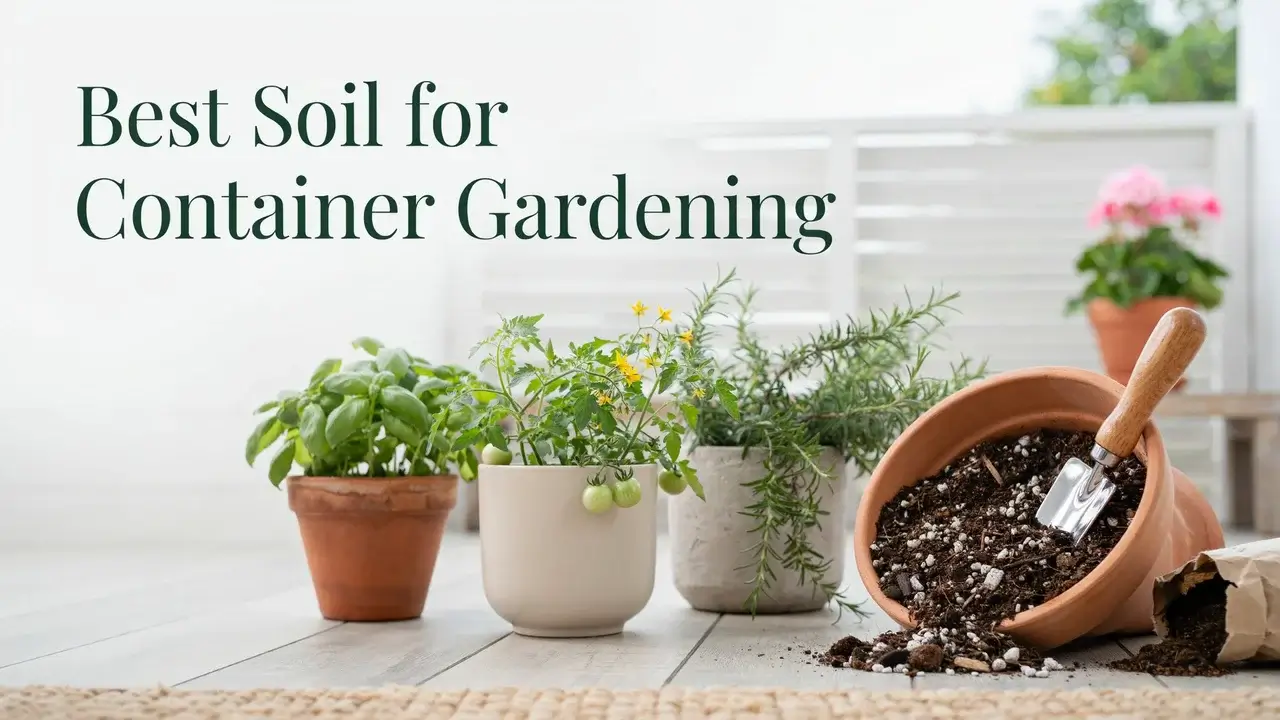
The best soil for container gardening is a lightweight potting mix that holds enough moisture for roots while still allowing excess water to drain and air to move through the container. Ordinary garden soil usually does not provide that balance when used alone in pots.
A good container mix combines moisture-holding materials such as peat moss or coconut coir with ingredients that improve structure and aeration, such as perlite, vermiculite, or bark. Compost can contribute organic matter and nutrients.
There is no single perfect mix for every plant. The right choice depends on what you are growing, the container size, and how quickly the pot dries in its location.
What Is the Best Soil for Container Gardening?
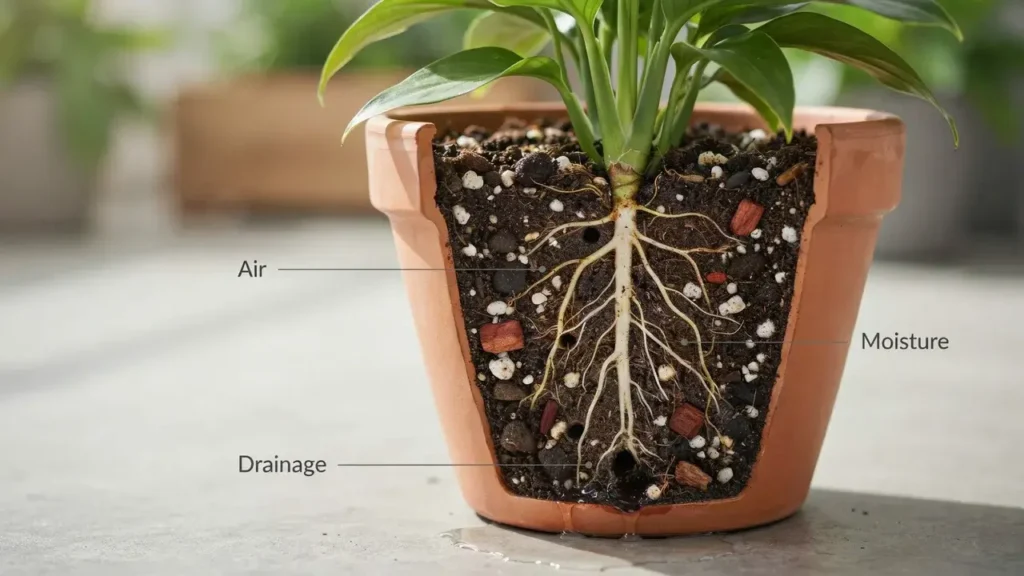
For most container plants, start with a quality potting mix formulated specifically for pots and planters rather than soil dug from the garden.
A good container growing medium should provide four things:
| Property | Why it matters |
|---|---|
| Drainage | Lets excess water move out of the root zone |
| Aeration | Keeps oxygen available around roots |
| Moisture retention | Prevents the pot from drying too quickly |
| Stable structure | Helps resist compaction as the season progresses |
Container roots are confined to a relatively small volume of growing medium. They cannot simply spread into surrounding ground to find better air, moisture, or nutrients.
NC State Extension notes that high-quality container media must allow both water and air to move through the mix while also retaining enough moisture for plant use. It also emphasizes that no single potting mix is ideal for every container-grown plant.
This is why choosing the right growing medium is one of the foundations of successful container gardening.
Potting Mix vs Garden Soil for Containers
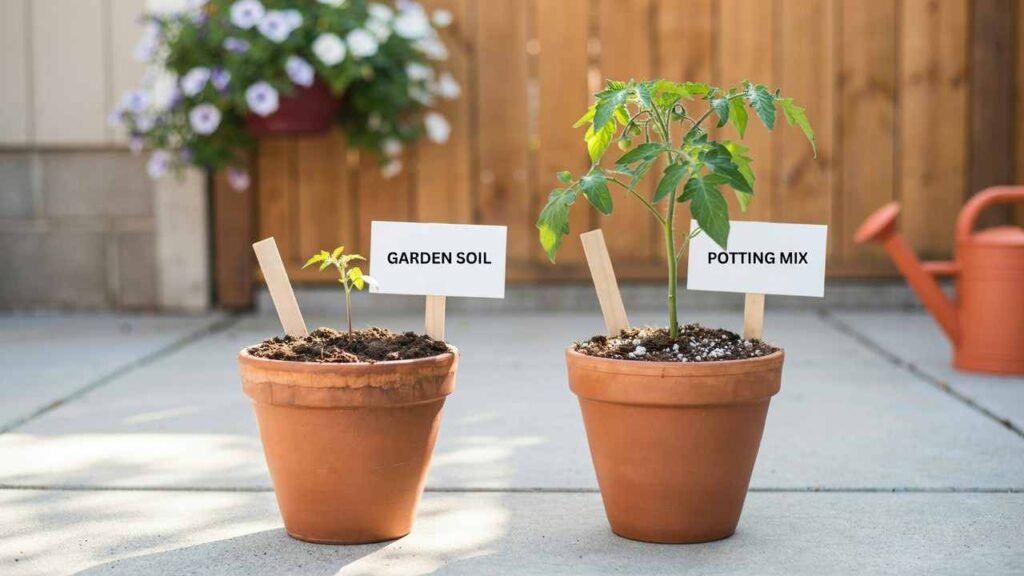
Garden soil may look rich and healthy in a garden bed, but conditions change once that same soil is placed inside a pot.
Can I use garden soil in pots?
Garden soil is generally not recommended as the main growing medium in containers.
Soil taken directly from the ground tends to be heavier and can lose important pore space when confined in a pot. Reduced pore space limits the movement of air and water around roots.
UC Master Gardener guidance recommends using soil or potting mix specifically designed for containers rather than filling pots with ordinary ground soil. NC State gives similar guidance, noting that field soil can be heavy, hold too much water, and provide too little oxygen around container roots.
| Feature | Container potting mix | Garden soil |
|---|---|---|
| Weight | Usually lightweight | Usually heavier |
| Aeration | Designed to maintain pore space | Can compact in pots |
| Drainage | Formulated for containers | Highly variable |
| Moisture retention | Balanced by ingredients | Depends on native soil |
| Best use | Pots and planters | Garden beds and landscapes |
Is garden soil completely unusable?
The answer is more nuanced than simply saying that no mineral soil can ever enter a container.
Some Extension recommendations allow a small proportion of topsoil in certain container mixes, especially in very large pots. University of Maryland guidance, for example, limits topsoil to a small percentage of the total volume in large containers. Illinois Extension also describes soil-based mixes as an option when used with soilless media.
For a beginner, however, a prepared potting mix is much easier to manage consistently.
What Makes a Good Container Potting Mix?
The quality of a mix is not determined by how dark or rich it looks.
What matters is the balance between solid particles and the spaces between them.
Drainage
Water should move through the container rather than remaining around roots indefinitely.
A well-draining potting mix still holds moisture. “Well draining” does not mean water should disappear through the pot immediately without wetting the root zone.
Aeration
Roots need oxygen as well as water.
Large pore spaces allow air to move through the growing medium. When a mix becomes compressed, those spaces shrink and root conditions can deteriorate.
Water-holding capacity
Container plants can dry much faster than plants growing in garden beds.
Ingredients such as peat moss, coir, vermiculite, compost, and fine organic materials can help retain moisture. The amount needed depends on the plant and growing conditions.
Low compaction
A good mix should remain relatively loose rather than forming a dense mass after repeated watering.
NC State identifies permeability, water-holding capacity, aeration, fertility, and suitable bulk density among the important properties of container growing media.
Common Ingredients in Container Soil Mixes
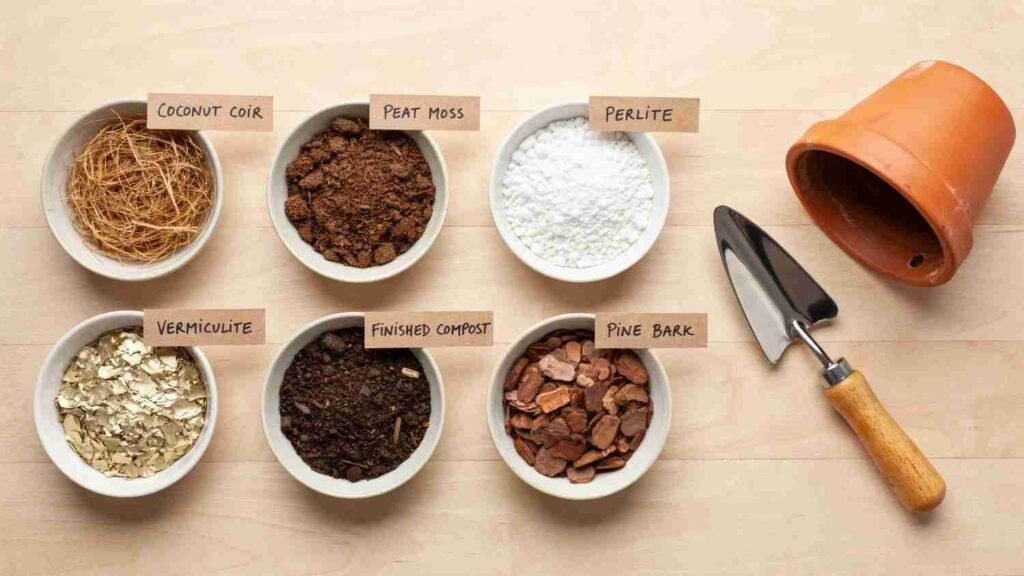
Potting mixes can contain many different ingredients. Each serves a different purpose, so there is no reason every bag must contain the same combination.
| Ingredient | Main role in a potting mix |
|---|---|
| Peat moss | Holds moisture and helps create a lightweight mix |
| Coconut coir | Retains moisture and adds organic structure |
| Perlite | Increases air space and improves drainage |
| Vermiculite | Holds moisture and some nutrients |
| Compost | Adds organic matter and nutrients |
| Pine or composted bark | Adds structure and larger air spaces |
| Sand | Adds weight and can change drainage characteristics |
NC State lists perlite, pine bark, sand, sphagnum peat moss, and vermiculite among common components of soilless media. University of Maryland also lists coir and compost among widely used materials.
Peat moss or coconut coir
Both are commonly used to help a mix retain moisture.
Peat can become difficult to rewet if allowed to become extremely dry. Coir is another widely used moisture-holding material and can replace part or all of the peat in some mixes.
Neither ingredient needs to appear in every container recipe.
Perlite
The small white particles commonly seen in bagged potting mix are often perlite.
Perlite creates larger air spaces and can improve drainage without adding much weight. It is particularly useful when a mix feels too dense.
Vermiculite
Vermiculite can hold more moisture than perlite and contributes to water retention.
It may be useful in mixes for plants with relatively high water requirements. NC State specifically notes that water-demanding plants can benefit from growing media with greater water-holding capacity.
Compost
Finished compost contributes organic matter and nutrients.
It can be an excellent component of container mixes, but it changes physically as it ages. Organic particles gradually break down, reducing pore space over time.
Fresh compost should also be mature and appropriate for plant use rather than unfinished material still actively decomposing.
Potting Soil vs Potting Mix: Does the Name Matter?
Terms on commercial bags can be confusing.
You may see:
- potting soil
- potting mix
- container mix
- planting mix
- growing media
- container substrate
The wording alone does not always tell you exactly what is inside.
Many products sold as “potting soil” are actually largely or entirely soilless growing media, despite having the word soil on the bag. University of Maryland describes potting soil, potting mix, and container substrate as overlapping terms used for container growing media.
Instead of choosing a product only by its name, check:
- whether it is intended for containers
- the main ingredients
- whether fertilizer is already included
- whether it contains moisture-retaining materials
- whether it contains ingredients that maintain aeration
- whether it is formulated for a particular plant group
A lightweight, fluffy container mix is usually a better starting point than a dense bag of topsoil or garden soil.
How to Choose Bagged Potting Soil for Containers
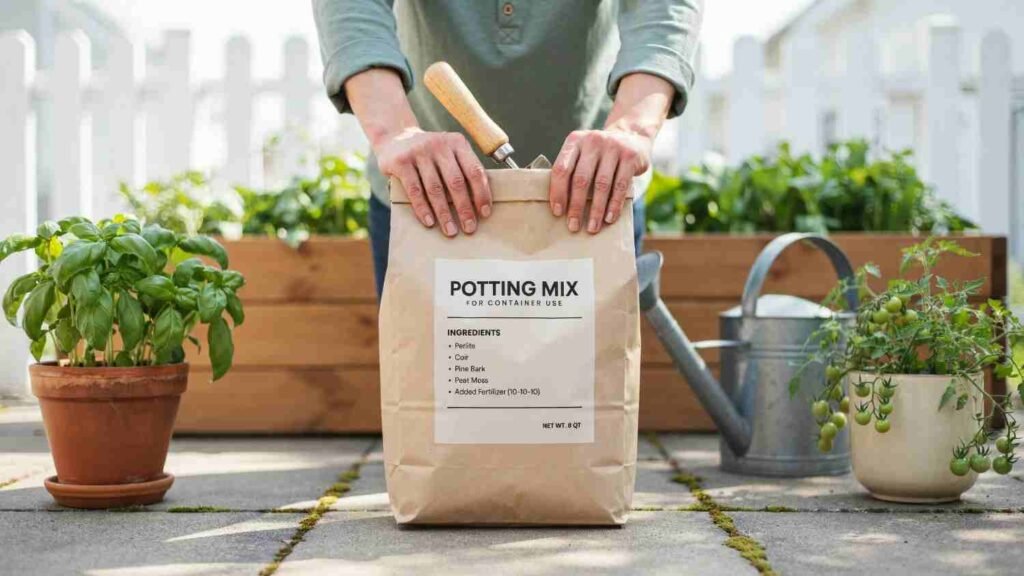
You do not need to buy the most expensive bag to get good results. Look for a product clearly labelled for containers, pots, or planters.
A useful general-purpose mix normally contains both moisture-holding and aeration ingredients. For example, peat or coir may provide water retention while perlite, bark, or similar coarse materials help maintain pore space.
UC Master Gardeners recommend looking for potting soil that feels lightweight rather than dense and heavy, with clearly listed ingredients and a formulation appropriate for the plants being grown.
Check for fertilizer
Many commercial mixes contain fertilizer.
That is not automatically good or bad, but you need to know it is there before adding more.
NC State notes that starter fertilizer included in some potting mixes may provide nutrients for only a limited period. Long-season plants may still need additional feeding according to their specific requirements.
Read the label before combining a fertilized mix with additional slow-release or liquid fertilizer.
Best Soil for Different Container Plants
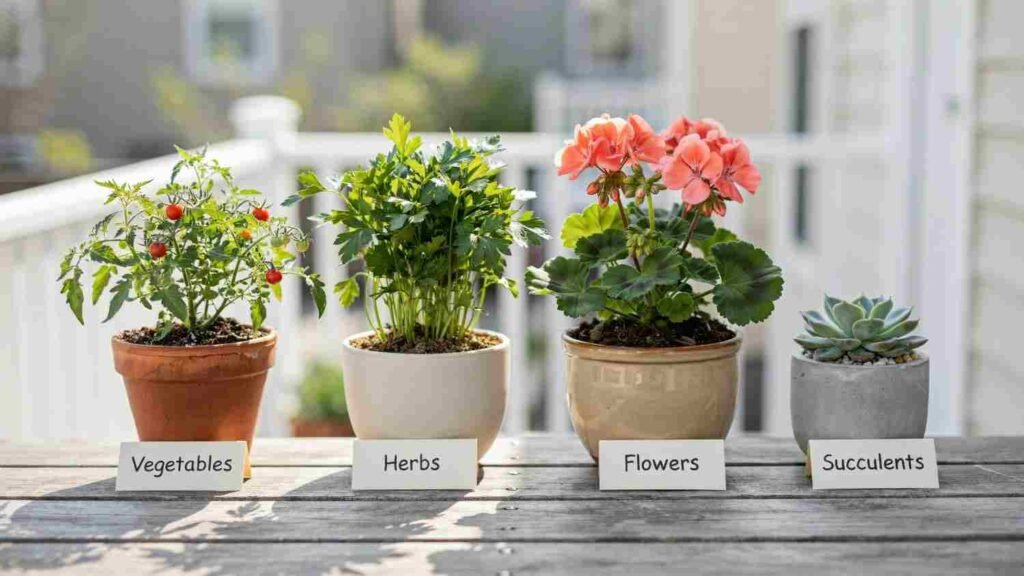
The best soil for container gardening changes slightly depending on what you grow.
A mix that works well for a thirsty vegetable may hold too much water for a plant adapted to dry conditions.
| Plant group | Main priority |
|---|---|
| Fruiting vegetables | Moisture retention, fertility, and drainage |
| Leafy vegetables | Even moisture and adequate nutrients |
| Most annual flowers | Balanced general-purpose mix |
| Mediterranean herbs | Faster drainage and good aeration |
| Moisture-loving plants | Greater water-holding capacity |
| Succulents and cacti | High aeration and fast drainage |
Vegetables in containers
Most container vegetables benefit from a mix that remains moist without becoming waterlogged.
Large fruiting vegetables such as tomatoes can use considerable water as they mature. NC State recommends greater water-holding capacity for high-water-use plants, while still maintaining sufficient aeration.
If you are deciding what to plant, see our guide to the best container vegetables.
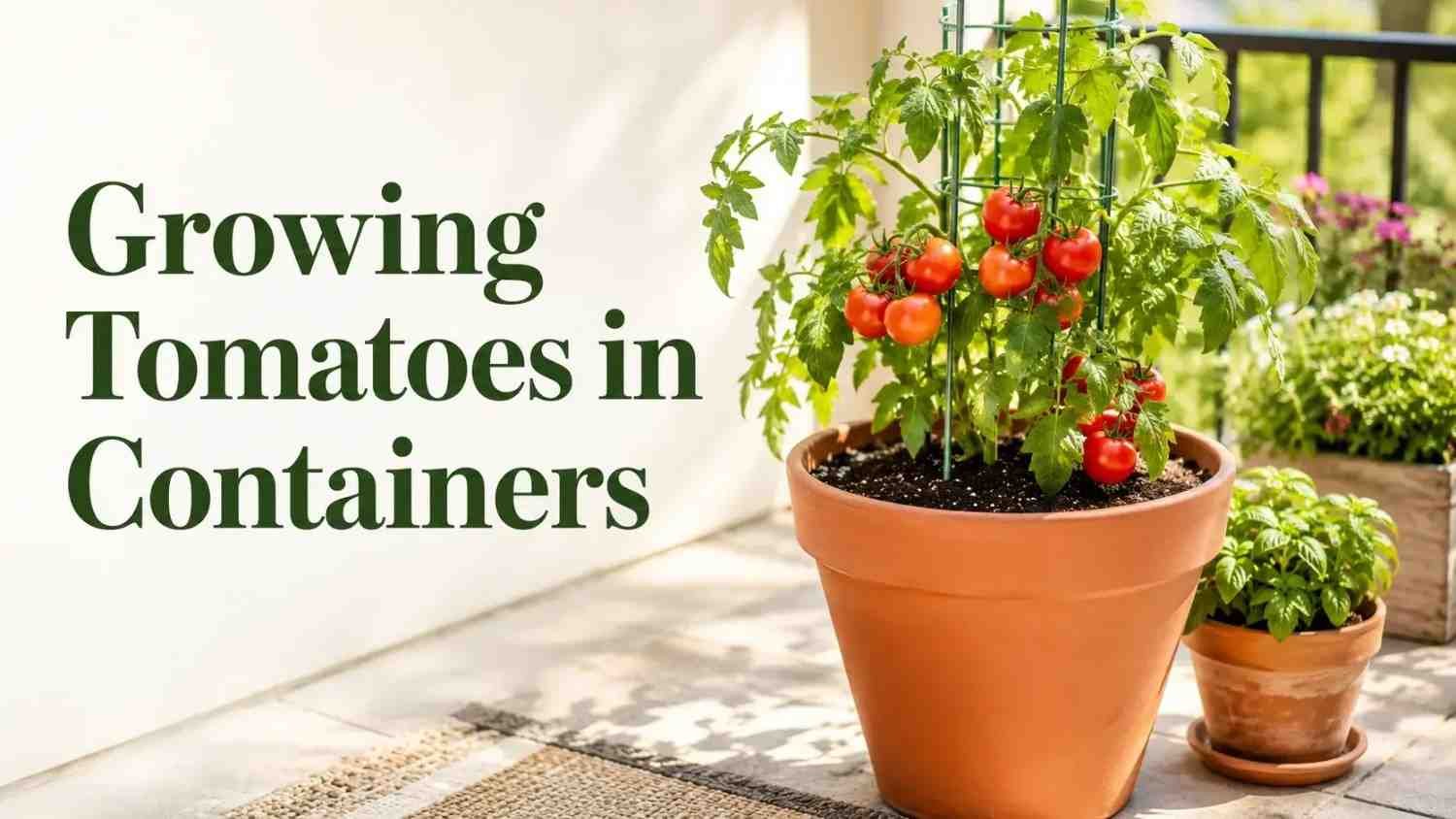
Tomatoes also have their own watering, feeding, and support needs once established. Our guide to growing tomatoes in containers covers those steps in detail.
Herbs
Avoid treating all herbs as though they want the same soil.
Basil and mint generally use more moisture than herbs adapted to dry Mediterranean conditions. Match the mix to the actual plant rather than buying something simply labelled “herb soil.”
Dry-loving plants
Succulents, cacti, and other plants sensitive to prolonged wet roots need more air space and faster drainage.
A general potting mix can sometimes be amended with coarse materials such as perlite or pumice to suit those conditions.
How to Make the Best Soil for Container Gardening at Home
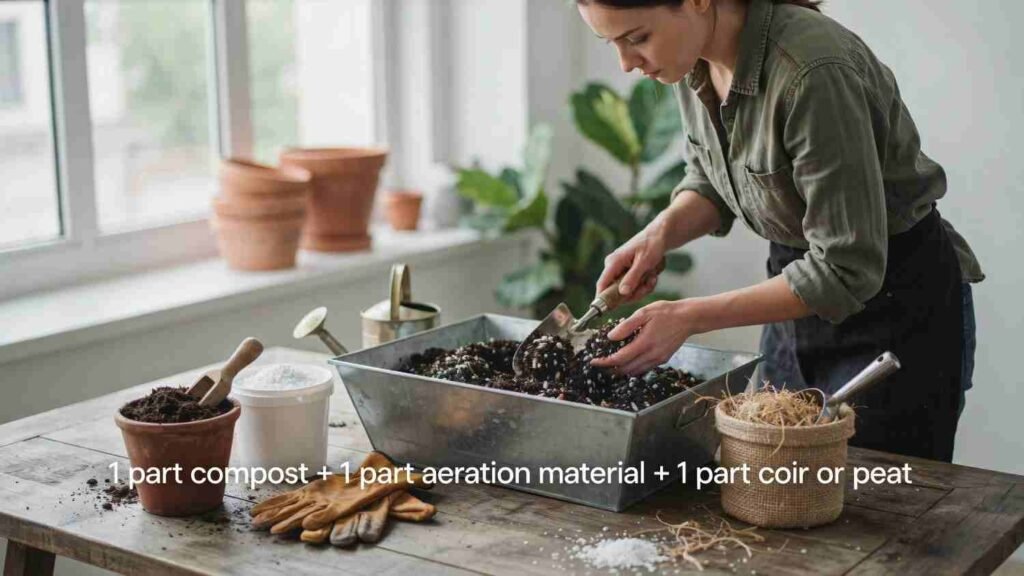
Making your own mix can be useful when filling many pots or when you want more control over drainage and moisture retention.
One practical starting recipe in current UC Agriculture and Natural Resources guidance uses equal parts:
- Finished compost
- Perlite or vermiculite
- Coconut coir or peat moss
The three components provide nutrients and organic matter, air space and drainage, plus moisture retention.
Treat this as a starting formula, not a universal recipe.
NC State lists several successful growing-medium combinations with different proportions of peat, perlite, vermiculite, bark, and sand. The appropriate mix depends on plant requirements and growing conditions.
Adjust the mix rather than chasing a perfect recipe
If the mix stays wet too long:
- increase coarse, aerating material
- reduce very fine or highly water-retentive components
- check that the container itself drains freely
If the pot dries extremely quickly:
- increase moisture-holding material
- consider adding suitable compost
- use a larger container when practical
- account for wind, heat, and container material
The goal is not to reproduce one exact ratio. It is to create a root environment with both moisture and air.
How to Improve Drainage in Container Soil
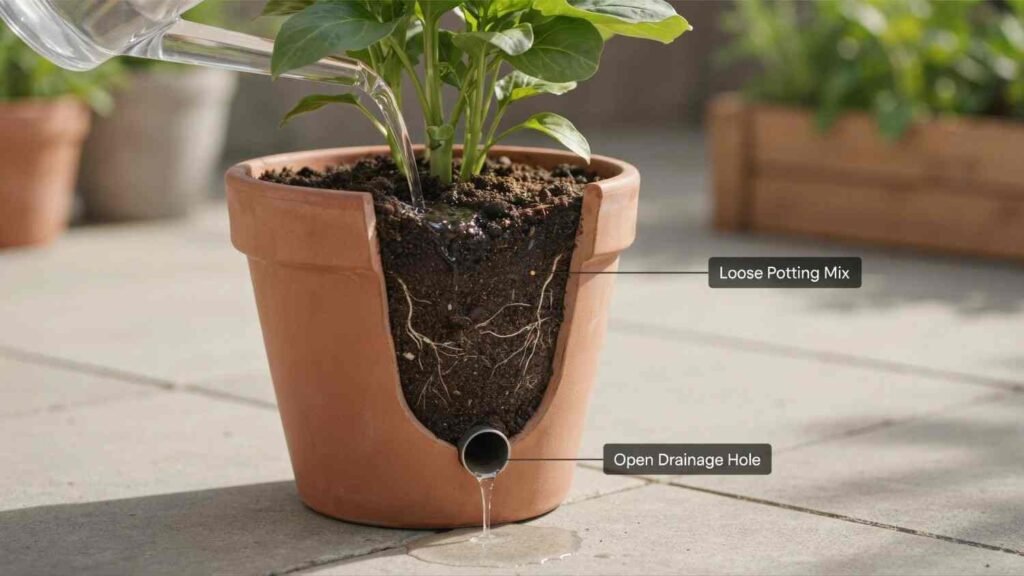
Good drainage starts with the growing medium and the container itself.
A well-structured potting mix helps water move downward while leaving air-filled pore spaces behind.
You can improve an overly dense mix by incorporating suitable coarse material such as:
- perlite
- pumice
- coarse bark
- an appropriate amount of coarse mineral material for the plant being grown
The pot also needs unobstructed drainage holes.
Do rocks at the bottom of pots improve drainage?
Adding a layer of gravel or stones to the bottom of a container is not necessary to improve drainage.
UC Master Gardener guidance specifically warns that gravel at the bottom can raise the saturated zone instead of fixing a poorly draining growing medium.
Use a properly draining mix and an open drainage hole instead.
Can You Reuse Old Potting Mix?
Yes, in many cases.
Do not reuse growing media from containers that had significant root disease problems. Disease organisms can remain in the old material and infect future plants.
If the plants were healthy, the mix can often be refreshed and reused.
University of Maryland recommends removing old plant debris and mixing used media roughly 50:50 with fresh growing media and/or finished compost before using it for another season. Nutrients should also be replenished as needed.
Why old potting soil changes
Organic ingredients gradually break down.
As particles become smaller, pore spaces shrink. This can reduce:
- drainage
- aeration
- root oxygen
- structural stability
NC State notes that reused container media can become increasingly compact as organic materials decompose. Breaking it apart and adding fresh growing media, compost, and nutrients can improve it when disease was not an issue.
If an old mix remains soggy, has become badly compacted, or no longer absorbs water evenly, replacement may be easier than trying to restore it.
Why Very Dry Potting Mix Sometimes Repels Water
Sometimes you water a dry pot and the liquid races down the sides without wetting the center.
The growing medium may have become hydrophobic, meaning it resists absorbing water.
Very dry peat-containing mixes are particularly prone to this problem. University of Maryland recommends moistening dry growing media before filling containers, especially when peat moss is present.
If a planted container becomes difficult to rewet:
- Apply water slowly rather than flooding the surface.
- Give the first application time to soak in.
- Water again gradually.
- Check whether the center of the root ball is actually moist.
For new containers, pre-moistening the potting mix until it feels evenly damp can prevent the problem from the start.
Common Container Soil Mistakes
Even a healthy plant can struggle when its root environment is wrong.
Filling pots with dense garden soil
Garden soil alone can compact and leave too little air around roots.
Use a medium designed for containers.
Choosing a mix that stays constantly wet
More moisture retention is not always better.
Roots need oxygen, so a potting mix must still drain effectively.
Using a mix that dries immediately
At the opposite extreme, a very coarse mix may require constant watering for moisture-loving plants.
Match drainage to the plant.
Packing the mix down firmly
Do not compress potting mix into the container.
NC State recommends filling containers loosely rather than tamping down the media because compaction reduces pore space.
Adding fertilizer without checking the bag
Your potting mix may already contain fertilizer.
Read the product label before adding more.
Using one mix for every plant
There is no universal formula that works equally well for tomatoes, herbs, flowers, and succulents.
Start with a quality general-purpose mix, then adjust its drainage and moisture retention when a plant has different needs.
Frequently Asked Questions
Can I use garden soil in pots?
Garden soil is usually not a good primary medium for containers because it can become dense and poorly aerated. Use potting mix formulated for containers instead. Small amounts of mineral soil can be incorporated into some specialized or very large-container mixes, but garden soil should not simply replace potting mix.
Is potting soil or potting mix better for containers?
Both labels may refer to products designed for containers. The ingredient list and intended use are more important than the exact wording on the bag. Choose a lightweight product that provides both moisture retention and aeration.
What is the best soil for outdoor potted plants?
For most outdoor pots, use a quality general-purpose container mix that drains well but still retains enough water for the plant. Adjust the mix for plants with unusually high or low moisture requirements.
Does container soil need compost?
Not every commercial potting mix needs additional compost. Compost can provide organic matter and nutrients, but the amount needed depends on the existing mix and the plant. Some successful container media contain compost, while others are entirely soilless.
Can I reuse potting soil from last year?
Yes, if the previous plants did not suffer from serious root disease. Remove old plant material and refresh the used medium with fresh potting mix and/or compost before planting again.
How can I make potting soil drain better?
Add an appropriate aerating material such as perlite, pumice, or coarse bark, avoid compacting the mix, and make sure the container has open drainage holes. Do not depend on a layer of gravel at the bottom to fix poor drainage.
Build a Better Root Environment in Every Pot
The best soil for container gardening is not simply the richest-looking material you can find. It is a growing medium that gives roots the right balance of air, moisture, structure, and nutrients.
For most gardeners, a quality commercial potting mix is the easiest starting point. From there, you can adjust water retention or drainage according to the plant, reuse healthy old media when appropriate, and make your own mix when you need more control.
Pay attention to how the mix behaves after repeated watering. If it stays saturated, compacts heavily, or stops absorbing water evenly, the root environment needs attention. Healthy container plants start below the surface.