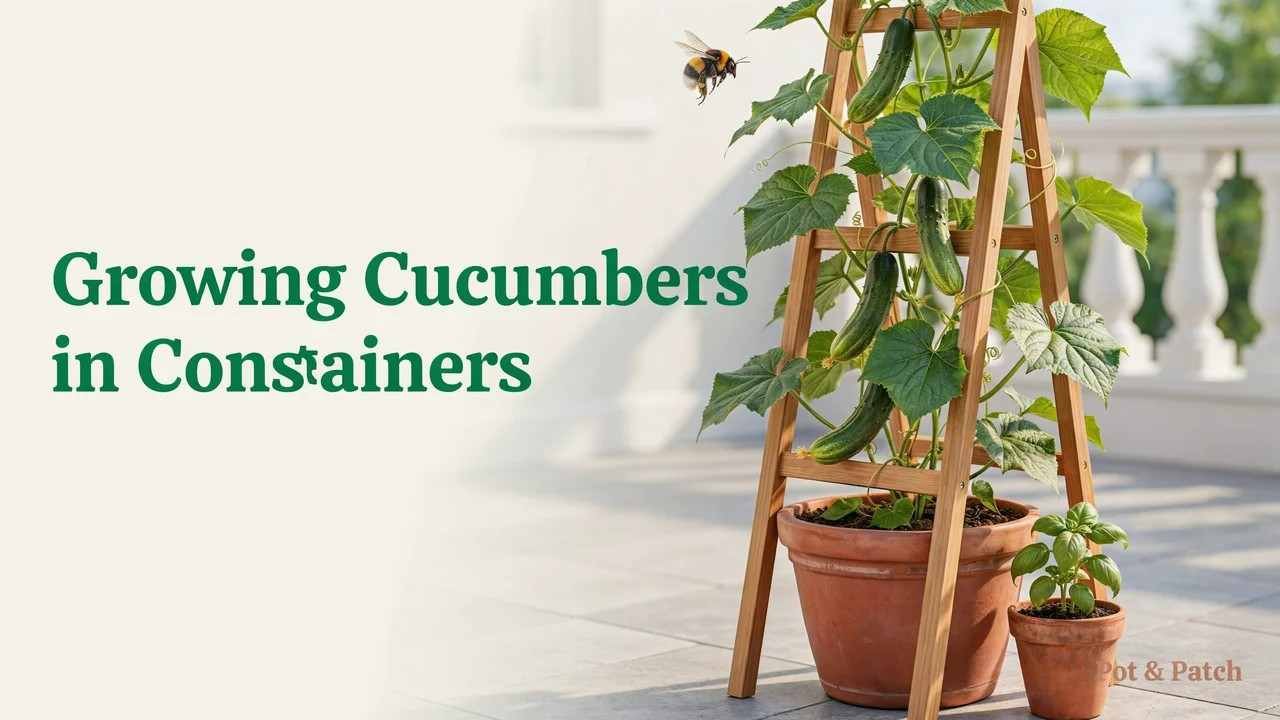
Growing Cucumbers in Containers: Beginner Guide from Planting to Harvest
Growing cucumbers in containers is a practical way to raise fresh slicing, pickling, and specialty cucumbers when you do not have a traditional garden bed. A sunny patio, balcony, deck, or compact backyard can provide enough room, especially when vigorous vines are trained upward.
Cucumbers grow quickly, but container plants need enough root space, strong sunlight, reliable moisture, and support. Choosing the right cucumber type also matters because compact bush plants and long vining varieties use space differently.
This guide covers the full process, from choosing a pot and sowing seeds to trellising vines, solving common problems, and harvesting crisp cucumbers.
Growing Cucumbers in Containers at a Glance
| Growing Requirement | Good Starting Point |
|---|---|
| Container size | At least 5 gallons for one plant, larger for vigorous vines |
| Container depth | About 12 to 18 inches is a useful range |
| Plants per pot | Usually 1 standard plant |
| Sunlight | At least 6 hours of direct sun |
| Soil | Lightweight, well-draining potting mix |
| Drainage | Working drainage holes |
| Support | Trellis for most vining varieties |
| Water | Keep moisture consistent and check frequently |
| Fertilizer | Vegetable fertilizer used according to label directions |
| Planting time | After frost danger has passed and conditions are warm |
| Harvest | Pick at the proper size for the variety |
A 5-gallon container is a useful minimum starting point for one cucumber plant, while larger pots can make watering easier and provide more stability for vigorous vines and trellises.
Can You Grow Cucumbers in a Pot?
Yes. Cucumbers can grow successfully in pots when the container is large enough and the plant has access to sun, water, nutrients, and support.
Container growing is especially useful in small spaces because a cucumber vine does not have to spread across the ground. A trellis allows the plant to grow upward instead.
Pots also let you control the growing medium and move the plant when necessary. The tradeoff is that containers dry faster than garden soil and depend more heavily on you for water and nutrients.
If you are new to growing vegetables in pots, our container gardening guide covers the broader setup without repeating it here.
Best Cucumbers to Grow in Containers
Not every cucumber grows the same way.
The most important distinction is between bush cucumbers and vining cucumbers.
Bush Cucumbers
Bush or compact varieties have shorter vines and are usually easier to manage in small spaces.
They are useful for:
- balconies
- patios
- small decks
- gardeners who do not want a tall trellis
Compact varieties are especially helpful when floor space is limited.
Vining Cucumbers
Traditional cucumber vines can grow much farther and benefit from vertical support.
They work well in containers when you provide:
- adequate root space
- a stable trellis
- regular watering
- enough vertical room for the vines to climb
Slicing, Pickling, and Specialty Cucumbers
You can also choose varieties according to how you plan to use the fruit.
| Cucumber Type | Main Use | Container Note |
|---|---|---|
| Slicing cucumber | Fresh eating | Many are vigorous vines |
| Pickling cucumber | Pickling and fresh use | Usually harvested while relatively small |
| Bush cucumber | Small spaces | Compact growth is easier to manage |
| Lemon cucumber | Fresh eating | Can be grown vertically |
| English-style cucumber | Fresh eating | Check variety size and pollination requirements |
The seed packet is particularly important with cucumbers. It tells you whether a variety is bush or vining and gives its expected spacing and harvest size.
What Size Container Do Cucumbers Need?
Start with at least a 5-gallon container for one cucumber plant.
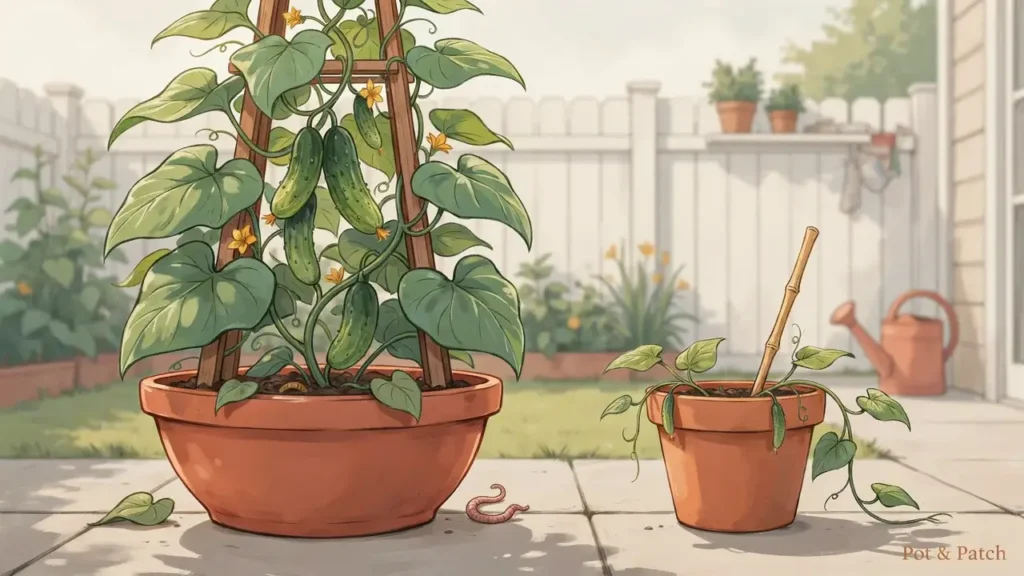
Five gallons should be treated as a minimum rather than the ideal maximum. A larger pot is often easier to manage because cucumbers grow quickly and use a substantial amount of water.
A larger container provides:
- more root space
- a larger moisture reserve
- greater stability for a trellis
- more growing medium to hold nutrients
- less rapid drying during hot weather
For vigorous vining cucumbers, choosing a wider and larger planter can make care easier.
How Many Cucumber Plants Per Pot?
For a standard 5-gallon container, one cucumber plant is the simplest beginner approach.
If you use a much larger planter, more than one plant may be possible when proper spacing can be maintained.
Avoid overcrowding just to get more vines. Too many plants in one pot compete for:
- water
- root space
- nutrients
- sunlight
- airflow
One healthy plant often performs better than several stressed plants crowded together.
Best Container Materials
Cucumbers can grow in plastic, ceramic, fabric, or other suitable containers.
What changes is how quickly the potting mix dries.
Plastic pots: Usually retain moisture longer.
Terracotta pots: Porous clay loses moisture faster and may need more frequent watering.
Fabric grow bags: Drain freely but can dry rapidly during hot weather.
Large planters: Often provide better stability when supporting tall cucumber vines.
Drainage Is Essential
Every cucumber container needs a way for excess water to escape.
Do not assume decorative pots automatically have drainage holes.
There is also no need to fill the bottom with rocks or broken pot pieces simply to improve drainage. Use a good potting mix and working drainage openings instead.
Do Container Cucumbers Need a Trellis?
Most vining cucumbers benefit from a trellis.
Bush types may stay manageable with little or no support, but vigorous vines can quickly spill over the sides of a pot and occupy a large area.
Trellising can:
- use vertical rather than floor space
- keep fruit away from the ground
- make harvesting easier
- improve access to flowers
- improve airflow around foliage
- help produce straighter fruit
Best Supports for Container Cucumbers
Useful options include:
- a sturdy garden trellis
- a tall tomato cage
- rigid wire panels
- a secured wooden frame
- strong garden netting attached to a stable frame
Choose the support based on the expected mature size of the variety.
Install the Trellis Early
Add support when planting or while the cucumber is still young.
Trying to push stakes into a mature container later can disturb roots.
Young vines can be gently directed toward the support. Once cucumber tendrils find something narrow enough to grip, the plant will usually begin climbing on its own.
Keep the Container Stable
A tall trellis covered in leaves and fruit can become top-heavy, especially in windy conditions.
Use a wide, stable container and secure tall supports properly.
A larger pot is particularly useful because it provides extra growing medium and greater physical stability.
If vertical food growing is a major part of your small garden, our vertical vegetable garden ideas guide covers broader layout ideas.
Best Soil for Growing Cucumbers in Containers
Growing cucumbers in containers requires a potting medium that can hold useful moisture while still allowing excess water to drain.
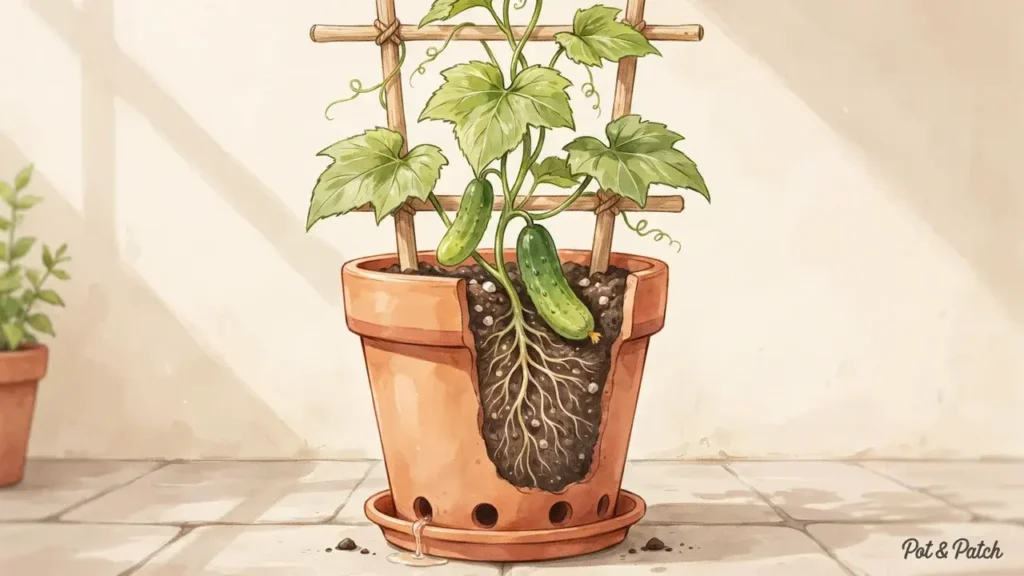
Do not fill the pot with dense soil dug directly from the garden.
A quality container potting mix gives roots a better balance of:
- moisture
- drainage
- oxygen
- structure
Cucumbers grow rapidly, so the root zone should not stay waterlogged or repeatedly become bone dry.
You do not need a complicated homemade mix for this crop. If you want more detail about potting media and amendments, see our guide to the best soil for container gardening.
When to Plant Cucumbers in Pots
Cucumbers are tender warm-season vegetables.
Do not rush them outside while nights are still cold or frost remains possible.
Wait until frost danger has passed and outdoor conditions have warmed consistently.
There is no single planting date for the entire United States.
Use:
- local frost dates
- current nighttime temperatures
- local soil and air conditions
- the maturity time of the variety
instead of relying only on the calendar.
Direct Sowing vs Transplants
Cucumbers can be grown either way.
Direct sowing is especially convenient because the seeds establish in their final container and the roots never need to be moved.
Transplants can provide an earlier start in cooler regions, but handle them gently because cucumber roots do not like unnecessary disturbance.
How Deep Should You Plant Cucumber Seeds?
Follow the seed packet for the specific variety.
Seed companies provide sowing depth and spacing recommendations for their cultivars, and those directions are more useful than forcing one universal number onto every cucumber.
Once seedlings emerge, avoid leaving several plants crowded together in a small container.
How to Plant Cucumbers in Containers Step by Step
Whether you start with seed or a transplant, prepare the permanent growing space before the plant gets large.
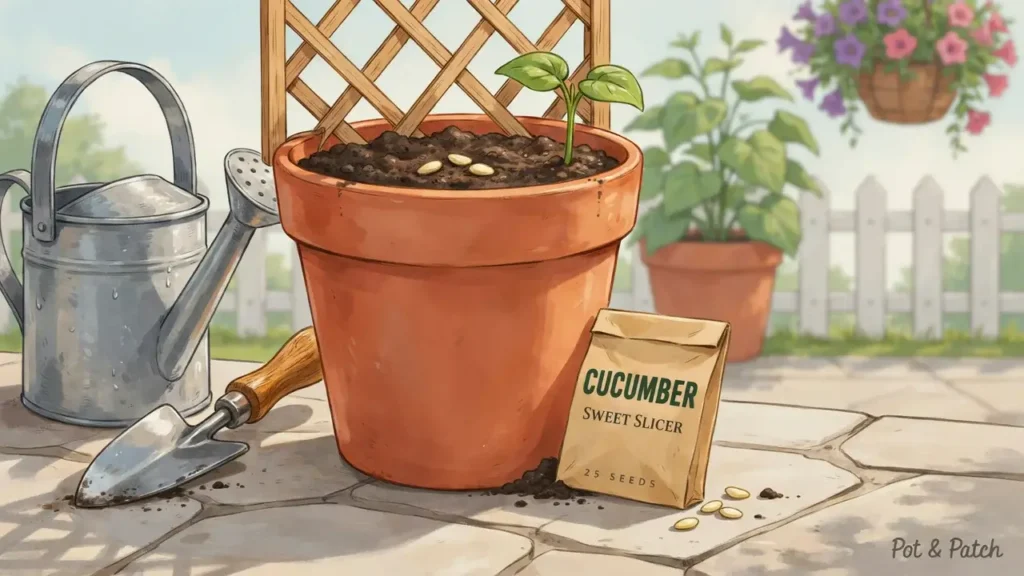
- Choose a suitable container. Use at least a 5-gallon pot for one standard cucumber plant.
- Check drainage. Make sure excess water can leave the bottom.
- Add potting mix. Fill the container with a lightweight growing medium.
- Moisten the mix. Dry potting media can be difficult to wet evenly after planting.
- Plant the seed or transplant. Follow the seed packet for sowing depth or handle a transplant carefully without disturbing its roots.
- Water thoroughly. Moisten the root zone and allow excess water to drain.
- Install the trellis. Do this immediately for a vining variety.
- Move the container into full sun.
- Thin extra seedlings if necessary. Avoid overcrowding.
- Guide new vines toward the support as they grow.
This keeps the cucumber in its final growing space from the beginning.
How Much Sun Do Potted Cucumbers Need?
Give cucumbers at least 6 hours of direct sunlight per day.
A bright patio is not automatically a full-sun location.
Watch your growing space throughout the day because:
- buildings cast long shadows
- balcony walls block morning or afternoon sun
- nearby trees change light levels as the season progresses
- railings and awnings can shade low-growing plants
A target of 6 to 8 hours of direct sun works well for most container cucumbers.
Once vines climb a trellis, make sure the upper growth is not being shaded by another structure.
How to Water Cucumbers Growing in Pots
Consistent watering is one of the most important parts of successful cucumber care.
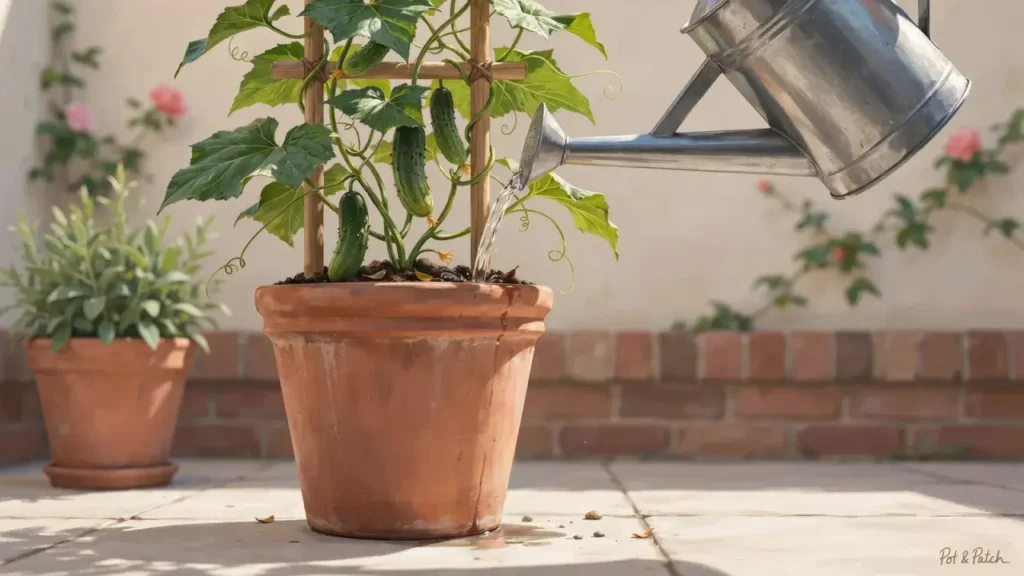
Cucumber vines use a substantial amount of water, especially once fruit starts developing. Do not use a rigid schedule such as “water every three days.”
How fast a pot dries depends on:
- container size
- container material
- air temperature
- wind
- sunlight
- plant size
- fruit load
- potting medium
Check the growing medium regularly. When watering is needed, moisten the root zone thoroughly rather than repeatedly adding tiny amounts to the surface.
As container plants become large and begin producing fruit, they may need daily attention during hot weather.
Signs the Pot May Need Water
Look for a combination of clues:
- dry upper potting mix
- noticeably lighter container
- drooping foliage
- rapid drying during hot or windy weather
- developing fruit during warm conditions
Check the growing medium before watering automatically.
Why Irregular Watering Affects Cucumbers
Moisture stress affects more than the leaves.
Irregular watering can contribute to fruit becoming:
- bitter
- pointed
- misshapen
That makes consistent moisture especially important once cucumbers begin developing.
The goal is not permanently wet soil. It is a reasonably steady supply of moisture combined with good drainage.
How to Fertilize Container Cucumbers
Cucumbers grow quickly and eventually use nutrients stored in a limited volume of potting mix.
First check the bag of potting mix because some products already include fertilizer.
If additional feeding is needed:
- choose fertilizer intended for vegetables or container crops
- follow the product label
- do not exceed the recommended rate
- adjust feeding to plant growth and the fertilizer already present
Repeated watering can gradually move nutrients out through drainage holes.
Avoid assuming that a struggling cucumber simply needs more fertilizer. Poor light, root crowding, irregular watering, disease, or temperature stress can create similar symptoms.
How to Train Cucumber Vines Vertically
Once a vining cucumber begins producing longer stems, guide them gently toward the trellis.
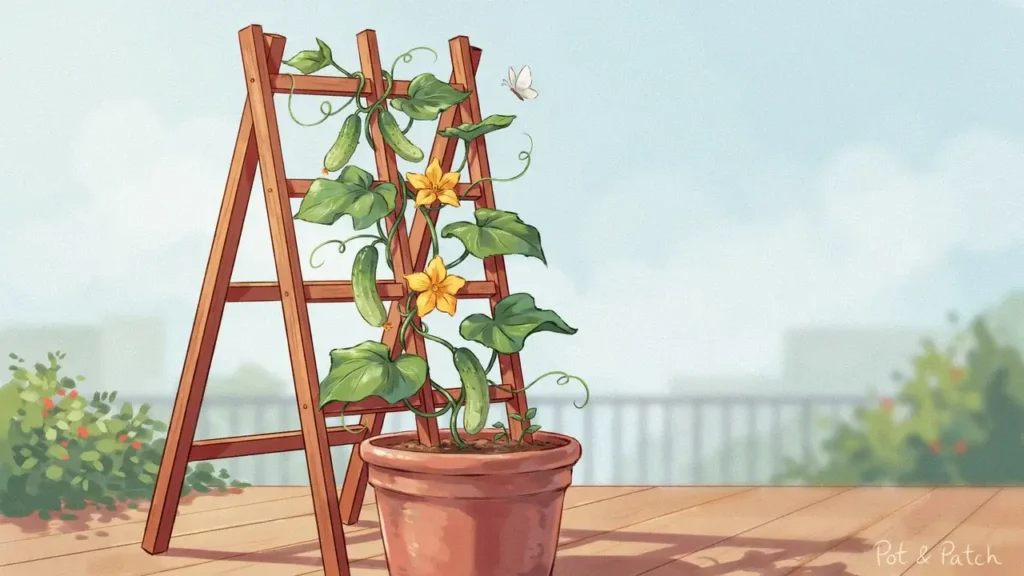
Cucumber vines produce tendrils, small curling structures that wrap around nearby supports.
To help the plant climb:
- Position new vines near the support.
- Guide them loosely rather than tightly tying them.
- Keep heavy vines from falling away from the trellis.
- Make sure growing tips have somewhere to continue climbing.
- Avoid crushing or sharply bending stems.
Do not repeatedly reposition mature vines once they have attached themselves firmly.
Vertical growth is especially useful on balconies and patios because the plant’s root area stays compact while much of its foliage occupies unused vertical space.
Cucumber Flowers but No Fruit: What Is Happening?
Seeing flowers without cucumbers does not automatically mean something is wrong. Many standard cucumber varieties produce separate male and female flowers.
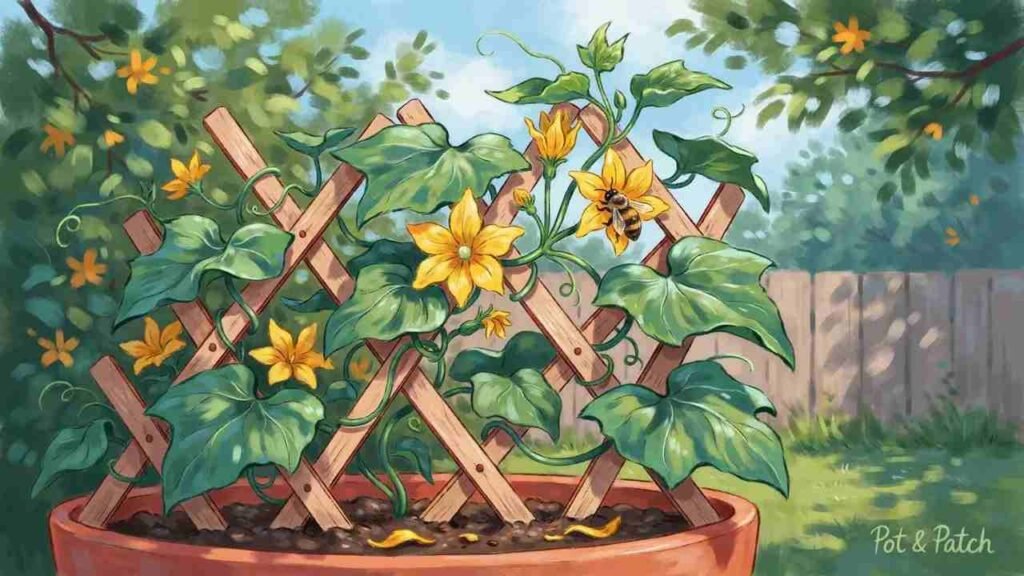
Male flowers may appear first. Female flowers can often be recognized by the tiny cucumber-shaped ovary behind the blossom.
For varieties that require pollination, bees and other pollinating insects transfer pollen between flowers.
Poor fruit development can occur when:
- pollinator activity is low
- temperatures are stressful
- the plant is experiencing water stress
- female flowers are not yet abundant
- the plant is still young
Do You Need to Hand-Pollinate Cucumbers?
Usually not when outdoor plants receive regular pollinator visits.
Hand pollination may be useful when pollinator activity is consistently poor, but first confirm that the variety actually requires pollination.
What Are Parthenocarpic Cucumbers?
Some cucumber varieties can develop fruit without pollination. These are called parthenocarpic cucumbers.
They can be particularly useful in protected growing conditions where pollinating insects have limited access.
Check the seed packet because pollination requirements differ among varieties.
Common Problems When Growing Cucumbers in Containers
Growing cucumbers in containers can reduce some garden-space problems, but the plants can still face moisture stress, pests, and disease.
Yellow Leaves
Yellow leaves can result from several causes, including:
- excess moisture
- prolonged dryness
- nutrient problems
- root crowding
- pest damage
- disease
- natural aging of older leaves
Do not apply fertilizer automatically.
Check root-zone moisture, drainage, and both sides of the leaves first.
Wilting
Wilting may indicate dry soil, but it can also occur during intense heat or because of root and disease problems.
Check the potting mix before adding more water.
A saturated container should not receive extra water just because foliage looks limp.
Bitter Cucumbers
Bitterness can be associated with environmental stress.
Irregular moisture is one important factor, so keep the root zone more evenly moist while fruit develops.
Misshapen Cucumbers
Poorly shaped fruit can have several causes.
Possible factors include:
- uneven moisture
- incomplete pollination
- plant stress
- nutrient problems
Check the plant’s overall growing conditions rather than focusing on only one cause.
Powdery Mildew
Powdery mildew can appear as pale, powdery growth on cucumber foliage.
Good plant spacing, airflow, and healthy growing conditions can help reduce disease pressure.
Avoid crowding multiple vigorous vines into one small container.
Cucumber Beetles and Other Pests
Inspect plants regularly rather than waiting until damage becomes severe.
Pay attention to:
- young leaves
- flowers
- growing tips
- leaf undersides
Cucumber beetles are especially important because they can damage foliage and spread bacterial wilt.
Identify the pest before choosing a treatment.
How and When to Harvest Container Cucumbers
Do not wait for cucumbers to become enormous before harvesting.
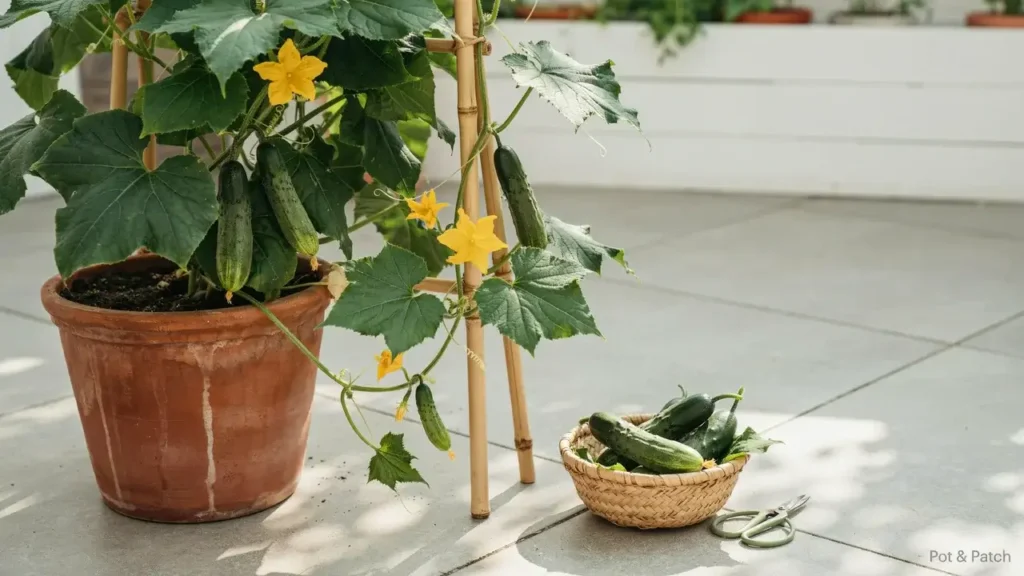
Fruit is generally best when picked at the size expected for the variety and before it becomes overmature.
As a general guide:
- Pickling cucumbers: often harvested around 2 to 4 inches
- Slicing cucumbers: often harvested around 5 to 8 inches, depending on the variety
The seed packet remains the best guide for your specific cultivar.
Check plants frequently once harvesting starts because cucumbers can increase in size quickly.
Regular picking also prevents oversized fruit from remaining on the plant unnecessarily.
Handle vines gently while harvesting. Avoid twisting or tearing stems.
7 Common Mistakes When Growing Cucumbers in Containers
1. Choosing a Container That Is Too Small
Small pots dry quickly, restrict root space, and can become unstable once a tall trellis is covered in vines.
2. Growing a Vigorous Vine Without Support
A vining cucumber can quickly spread across a balcony or patio. Install a trellis while the plant is young.
3. Using an Unstable Trellis
A tall support needs a stable pot and secure attachment. Wind can easily topple a top-heavy cucumber container.
4. Letting the Pot Repeatedly Dry Out
Irregular moisture can stress the plant and contribute to bitter or misshapen fruit.
5. Giving Cucumbers Too Little Sun
Cucumbers are fruiting plants and need strong direct light. A bright but shaded location may not be enough.
6. Crowding Too Many Plants Into One Pot
More seedlings do not automatically mean a larger harvest. Overcrowding increases competition for water, nutrients, root space, and airflow.
7. Leaving Mature Cucumbers on the Vine Too Long
Harvest fruit at the appropriate size for the variety and check productive vines frequently.
Frequently Asked Questions
Can you grow cucumbers in a 5-gallon bucket?
Yes. A 5-gallon bucket can work for one cucumber plant, especially if it has good drainage and the plant receives enough water, sunlight, and support. A larger container can be easier to manage for vigorous vines.
How many cucumber plants can grow in one pot?
For a standard 5-gallon container, one plant is the simplest recommendation. Larger planters can hold more plants when proper spacing, root volume, water, and nutrients are available.
Do cucumbers need a trellis in containers?
Vining cucumbers benefit strongly from a trellis. Bush varieties may need little or no support. A trellis saves floor space and keeps vigorous vines easier to manage.
How deep should a cucumber container be?
A depth of about 12 to 18 inches is a useful starting range for cucumbers. The container should also provide enough overall volume for roots and moisture.
Can I grow cucumbers from seed directly in a pot?
Yes. Direct sowing works well once frost danger has passed and conditions are warm. It also avoids disturbing cucumber roots during transplanting.
Why are my container cucumbers bitter?
Environmental stress, especially irregular moisture, can contribute to bitterness. Keep the root zone more consistently moist while fruit develops.
Can cucumbers grow on a balcony?
Yes, provided the balcony receives enough direct sunlight and has room for a suitable container and secure vertical support. Also consider wind exposure and the stability of the entire setup.
Growing Cucumbers in Containers Successfully
Growing cucumbers in containers works best when you give the plant enough root space and somewhere for its vines to go.
Start with a roomy pot and quality potting mix, provide at least six hours of direct sunlight, and install a strong trellis early if you choose a vining variety. Check moisture frequently because mature cucumber vines use substantial amounts of water, especially while fruit is developing.
With steady care and regular harvesting, a single well-managed cucumber plant can make productive use of a patio, balcony, deck, or other small garden space.