
Tomato Hornworms: How to Identify, Get Rid of, and Prevent Them
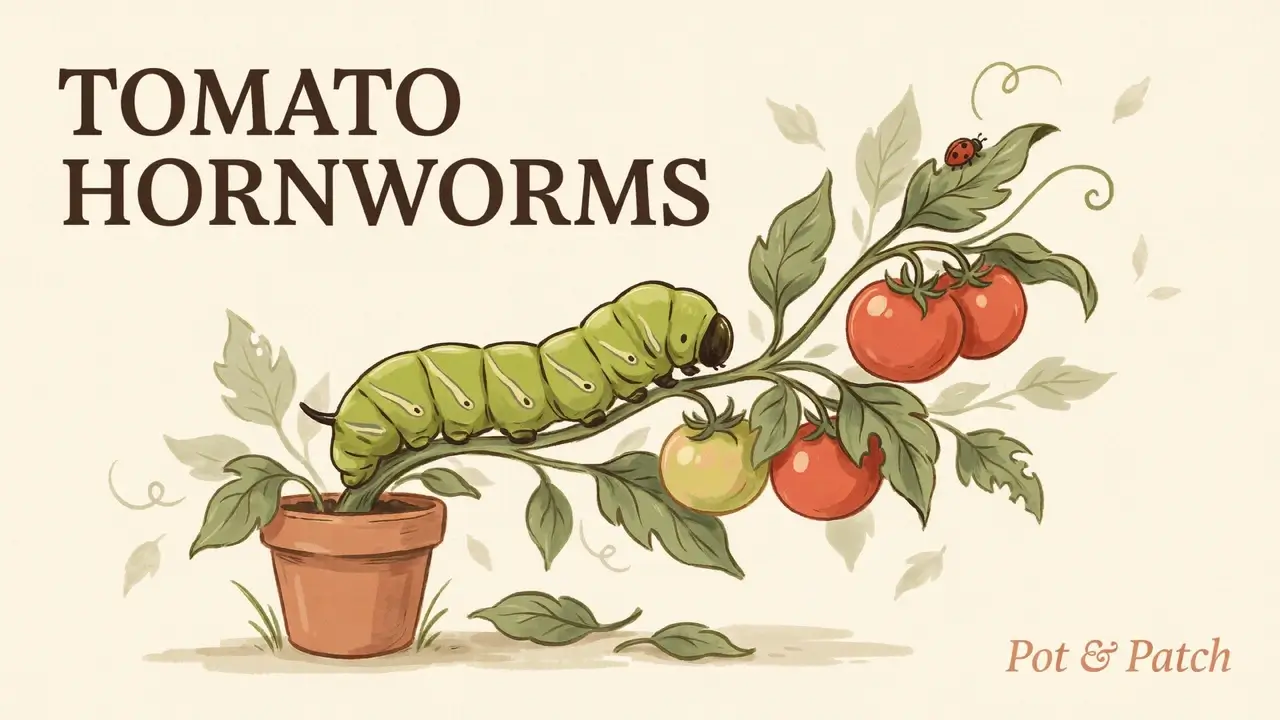
Tomato hornworms can turn a healthy tomato plant into a collection of bare stems surprisingly quickly. These large green caterpillars hide among the leaves, making them difficult to spot until noticeable damage has already occurred.
If you find missing leaves, chewed green tomatoes, or dark droppings beneath the foliage, a hornworm may be responsible. The good news is that most home-garden infestations are manageable without complicated treatments.
The first step is to identify the caterpillar, check nearby branches for others, and remove active hornworms by hand. However, if you find one covered with tiny white cocoons, leave it alone. Beneficial parasitic wasps are already controlling that caterpillar.
What Are Tomato Hornworms?
Tomato hornworms are large caterpillars that feed on tomato leaves, stems, and sometimes fruit. They are the larval stage of the five-spotted hawkmoth (Manduca quinquemaculata), a member of the sphinx moth family.
Unlike earthworms, these caterpillars live above ground and feed on plants. Their name comes from the pointed, horn-like projection at the rear of their bodies.
Although tomatoes are a preferred host, hornworms may also feed on other plants in the nightshade family (Solanaceae), including peppers, eggplants, potatoes, and certain weeds.
Gardeners frequently confuse tomato hornworms with tobacco hornworms (Manduca sexta). Both species attack tomatoes, cause similar damage, and can be controlled using the same methods.
They are especially troublesome during summer when warm weather supports caterpillar development. A large caterpillar consumes substantially more foliage than a newly hatched one, so catching an infestation early makes a considerable difference.
How to Identify Tomato Hornworms
A mature tomato hornworm is a thick, smooth-bodied green caterpillar that can reach approximately 4 inches long.
Despite its size, it blends remarkably well with tomato foliage. Its coloring, pale body markings, and position along green stems can make it nearly invisible.
What Does a Tomato Hornworm Look Like?
Look for these identifying features:
- Large green body: Mature caterpillars are thick, cylindrical, and usually bright green.
- Eight white V-shaped markings: These appear along the sides of a mature tomato hornworm.
- Dark rear horn: A black or blue-black horn projects upward from the last abdominal segment.
- Smooth-looking skin: The body lacks the dense hairs found on some other caterpillars.
- Strong gripping legs: The caterpillar holds tightly to stems and leaves while feeding.
Young hornworms look different from mature ones. Newly hatched larvae are small and pale, and their distinctive side markings become more obvious as they grow.
The horn might look intimidating, but it is not a stinger.
Tomato Hornworm vs. Tobacco Hornworm
Finding a hornworm on a tomato plant does not necessarily mean it is a tomato hornworm.

Tobacco hornworms also feed on tomatoes and may be more commonly encountered in some parts of the United States.
The easiest way to tell these caterpillars apart is by examining their side markings and rear horns.
| Feature | Tomato Hornworm | Tobacco Hornworm |
|---|---|---|
| Scientific name | Manduca quinquemaculata | Manduca sexta |
| Body color | Usually green | Usually green |
| Side markings | Eight white V-shaped marks | Seven diagonal white stripes |
| Rear horn | Dark or black | Usually reddish-orange |
| Adult moth | Five-spotted hawkmoth | Carolina sphinx moth |
| Tomato damage | Leaves, stems, and fruit | Leaves, stems, and fruit |
Both species can grow to roughly 3 to 4 inches long and are managed similarly in home gardens.
If you cannot distinguish between them, do not worry. Identifying the exact species is helpful, but it is not necessary before removing an actively feeding caterpillar.
Signs of Tomato Hornworm Damage
You may notice damage several days before finding the caterpillar responsible.

Hornworms have powerful chewing mouthparts and often begin feeding on the upper portions of tomato plants. As they grow, their appetite increases dramatically.
Missing Leaves and Bare Stems
The most recognizable signs include:
- Entire leaves disappearing from upper branches.
- Large sections of foliage eaten away.
- Leaf stalks or short stems left behind.
- Rapid defoliation concentrated in one area.
- Large feeding gouges in green or ripening tomatoes.
Unlike smaller pests that leave scattered pinholes, hornworms often consume entire leaves or substantial portions of them.
A heavily infested plant may appear almost stripped overnight, especially when several large caterpillars are feeding.
Lost foliage also exposes developing tomatoes to more direct sunlight, increasing their risk of sunscald.
Other insects can produce chewing damage, so if you see small, irregular holes without the characteristic hornworm signs, consult our guide to holes in tomato leaves for a broader diagnosis.
Look for Hornworm Droppings (Frass)
One of the easiest ways to find a hidden hornworm is to look for its droppings, known as frass.
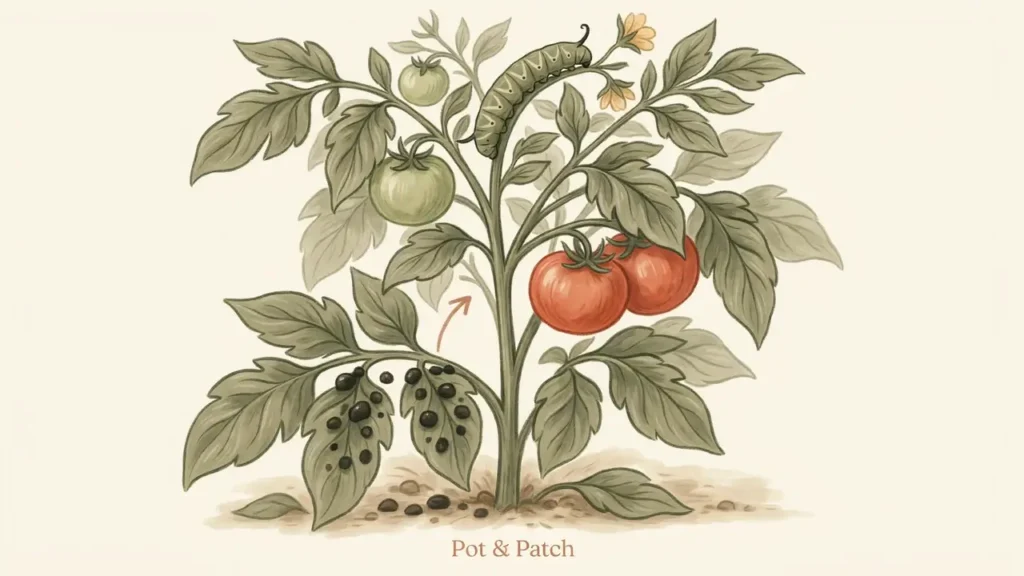
Hornworm frass appears as relatively large, irregular pellets on leaves, stems, or the soil beneath a plant.
Fresh droppings are often green. As they age and dry, they become darker brown or black.
If you find green pellets on a lower leaf, inspect the foliage and branches above that spot. The caterpillar may be feeding or resting directly overhead.
Older, darkened droppings still indicate hornworm activity, but the insect may have moved elsewhere on the plant.
This simple tracking method is particularly useful when the caterpillar’s green camouflage makes direct inspection difficult.
How to Find Hornworms on Tomato Plants
Hornworms are masters of camouflage, but you can usually locate them with a careful inspection.
Start with the most damaged parts of the plant instead of searching every leaf randomly.
Inspect Plants in the Morning or Evening
Early morning and evening are useful times to look because caterpillars may be easier to spot when they are feeding or moving.
Follow these steps:
- Begin at the upper branches where leaves are missing.
- Examine the undersides of nearby leaves.
- Look along thick green stems for a caterpillar resting lengthwise.
- Check for dark or green frass on lower foliage.
- Follow the droppings upward toward the feeding area.
- Inspect nearby tomato plants for additional caterpillars.
If you still cannot find anything, gently move the branches or lightly spray the foliage with water. Movement sometimes makes a hidden hornworm easier to notice.
Check again the following day if fresh damage continues.
Use a Blacklight to Spot Hidden Hornworms
A UV flashlight can make nighttime hornworm hunting easier.
Under suitable ultraviolet illumination, hornworms may appear bright green against foliage that looks reddish or orange.
Wait until dark, then slowly scan the leaves and stems with a handheld UV flashlight. Look closely at areas where you previously noticed feeding damage.
Once you locate a caterpillar, use an ordinary flashlight to confirm its identity before removing it.
Avoid shining the UV light into anyone’s eyes, and follow the flashlight manufacturer’s safety instructions.
This method is optional. Regular daylight inspection and frass tracking are usually sufficient for a few tomato plants.
How to Get Rid of Tomato Hornworms
Handpicking is usually the best way to get rid of tomato hornworms in a small home garden. It removes the pest immediately without exposing the entire plant to unnecessary insecticides.
If you grow tomatoes in containers, raised beds, or a small patio garden, you may only need to inspect a handful of plants.
1. Remove Hornworms by Hand
Once you locate an active caterpillar, remove it carefully.
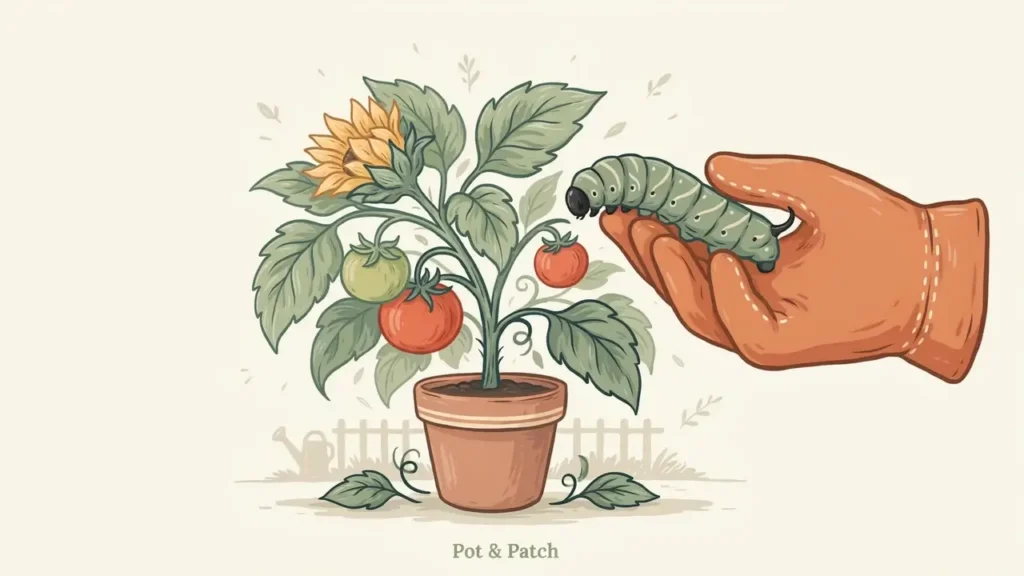
- Wear gardening gloves if you prefer not to touch caterpillars directly.
- Grasp the hornworm gently but firmly.
- Carefully release its gripping legs from the stem.
- Place it in a container of soapy water for disposal.
- Inspect the plant for additional hornworms.
Avoid pulling so hard that you break tender stems.
The rear horn is not a stinger, so it does not present the danger its appearance might suggest.
For a small infestation, this simple approach is often enough. Continue checking the plant over the next several days because smaller caterpillars may have escaped detection.
2. Protect Beneficial Insects
Not every hornworm needs to be removed.
Parasitic wasps, including braconid wasps, naturally attack these caterpillars. Some predators also feed on hornworm eggs or young larvae.
Paper wasps, lady beetles, and green lacewings can contribute to natural pest control in the garden.
Avoid spraying broad-spectrum insecticides unnecessarily, since they may kill helpful insects along with pests.
If a hornworm has small white rice-like cocoons attached to its body, leave it undisturbed. Those cocoons indicate that beneficial parasitoids have already developed inside the caterpillar.
3. Use Bt for Young Caterpillars When Needed
If repeated hand removal is impractical or several small hornworms are feeding, a product containing Bacillus thuringiensis subsp. kurstaki (Btk) may help.
Btk is a naturally occurring bacterium used in biological insecticides that target susceptible caterpillars.
It works when a caterpillar eats treated foliage. It is generally more effective against young, small larvae than large, mature hornworms.
Choose a product labeled for use on tomatoes and the target caterpillars. Follow all application directions, including mixing rates, protective precautions, and any restrictions before harvesting.
Bt is not a general-purpose insecticide for every garden pest, and it can also affect susceptible butterfly and moth caterpillars that consume treated foliage.
For a plant with only one or two large hornworms, hand removal remains the simpler option.
4. Consider Other Treatments Only When Necessary
Spinosad is another insecticide sometimes used against chewing caterpillars.
It may be appropriate when hornworm feeding is extensive and simpler control methods have not worked, provided the particular product is labeled for that use.
However, spinosad can harm bees when the treatment is wet. Keep it away from actively foraging pollinators and follow the product label carefully.
Avoid spraying automatically whenever you discover a damaged leaf. First determine whether active caterpillars are still present.
Use this quick decision guide:
| Situation | Recommended Action |
|---|---|
| One or two active hornworms | Remove by hand |
| Caterpillar covered with white cocoons | Leave it undisturbed |
| Several small caterpillars causing new damage | Consider labeled Btk treatment |
| Persistent, extensive feeding | Reinspect, remove pests, and evaluate labeled control options |
| No caterpillars or new feeding damage | Continue monitoring without spraying |
For tomatoes grown in containers, manual inspection is particularly convenient because the entire plant is usually within easy reach.
What Are the White Things on Tomato Hornworms?
If you find a hornworm covered with small white objects resembling grains of rice, you have probably discovered a caterpillar parasitized by beneficial wasps.

These structures are wasp cocoons, not eggs.
A female parasitoid wasp deposits eggs inside the hornworm. The developing wasp larvae feed internally before emerging and forming white cocoons on the outside of its body.
The parasitized hornworm stops feeding and eventually dies.
The adult wasps then emerge from their cocoons and may seek additional hornworms.
Do not remove or destroy a hornworm carrying these white cocoons. Leaving it undisturbed allows the beneficial wasps to complete their development.
This natural biological control can help reduce future hornworm populations without insecticide applications.
Tomato Hornworm Life Cycle
Understanding the tomato hornworm life cycle explains why caterpillars can appear suddenly and why some survive from one growing season to the next.
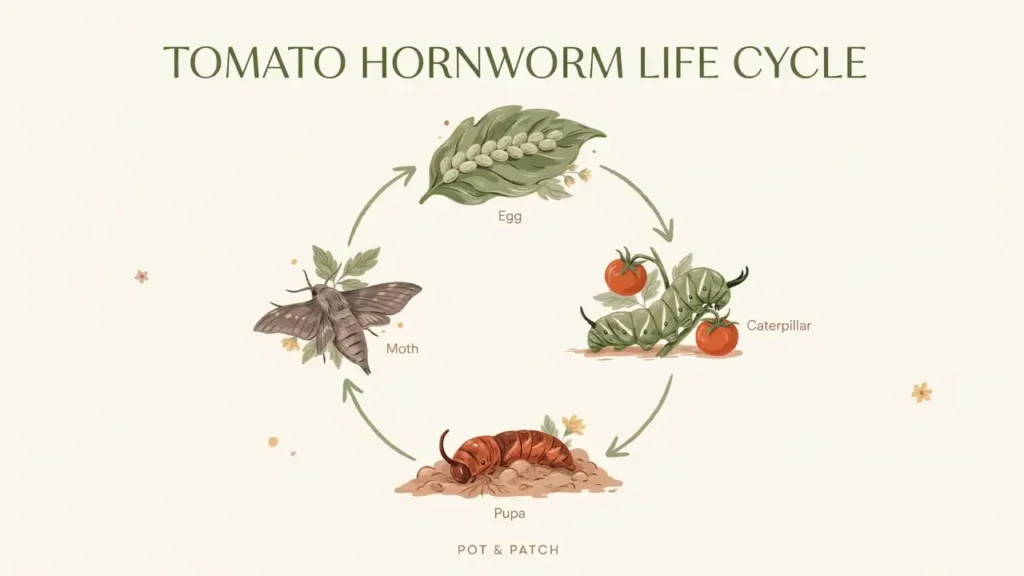
Tomato hornworms develop through four major stages: egg, larva, pupa, and adult moth.
1. Eggs
After mating, female hawkmoths lay small, smooth, pale green eggs on host plants.
Eggs are generally deposited individually, often on the undersides of leaves.
Because they are small and blend with the foliage, they are easy to overlook during ordinary garden inspections.
2. Caterpillar (Larval Stage)
The eggs hatch into tiny caterpillars that begin feeding on leaves.
As the larvae grow, they shed their skin and pass through successive developmental stages called instars.
Under favorable summer conditions, the larval period typically lasts around three to four weeks.
Most feeding damage occurs during the later stages when the caterpillar is much larger.
A small hornworm may go unnoticed for some time, but a mature one can consume substantial foliage over a short period.
3. Pupa in the Soil
When a caterpillar finishes feeding, it leaves the plant and burrows into the ground.
There, it transforms into a reddish-brown pupa with a distinctive curved structure near the head that houses the developing moth’s proboscis.
Unlike some other caterpillars, tomato hornworms do not spin a conventional silk cocoon around themselves.
Depending on the season, adults may emerge after pupal development or remain underground through winter.
This underground stage helps explain why hornworms may return to a garden the following year.
4. Adult Hawk Moth
The adult tomato hornworm is the five-spotted hawkmoth.
These moths have strong, narrow wings and gray-brown coloring. Their wingspan may reach approximately 4 to 5 inches.
Adults are most active around dusk and dawn, feeding on nectar from flowers.
After mating, females lay eggs on suitable host plants and the cycle begins again.
Depending on climate and location, hornworms may complete one or more generations during the growing season.
What Do Tomato Hornworms Turn Into?
Tomato hornworms turn into five-spotted hawkmoths (Manduca quinquemaculata), not butterflies.
Tobacco hornworms develop into a different species called the Carolina sphinx moth (Manduca sexta).
Both belong to the sphinx moth family, Sphingidae.
Their adult forms are large, fast-flying moths that may resemble hummingbirds while hovering near flowers.
Although the caterpillars damage tomato plants, adult hawkmoths feed on flower nectar and can contribute to pollination.
Seeing one of these moths in your garden does not necessarily mean an infestation is underway, but it is a good reason to watch tomato foliage for newly hatched caterpillars.
How to Prevent Tomato Hornworms
You may not be able to prevent every hornworm from reaching your garden, but regular monitoring and sensible pest management can reduce serious damage.
Inspect Tomato Plants Regularly
Check plants at least twice weekly during the summer, and more often if you have recently discovered hornworms.
Focus on new growth, upper foliage, leaf undersides, and areas where droppings are visible.
Removing a small caterpillar early prevents it from reaching the stage when it consumes the most foliage.
Remove Alternate Host Weeds
Hornworms can develop on other plants in the nightshade family.
Remove unwanted host weeds such as horsenettle, jimsonweed, and wild nightshade from around growing areas where practical.
This reduces alternative feeding and egg-laying sites.
Be careful when identifying unfamiliar plants, particularly in areas where desirable native plants may also support other wildlife.
Manage Soil After Harvest
Hornworms pupate underground and may overwinter in the soil.
Turning or cultivating soil after the growing season can expose or destroy some pupae. Crop rotation may also help in larger garden plots.
However, intensive digging is not always desirable in small raised beds or no-dig gardens because it disturbs soil structure and other soil organisms.
If you grow tomatoes in raised beds, weigh that trade-off rather than treating soil cultivation as mandatory.
Continue checking plants in future seasons even if you removed all visible caterpillars the previous year. Adult moths can fly into gardens from surrounding areas.
Encourage Natural Enemies
Beneficial insects help keep hornworm populations under control.
Avoid unnecessary broad-spectrum pesticide applications and preserve parasitized hornworms whenever possible.
A garden with diverse flowering plants can offer nectar and habitat for beneficial insects, although planting particular herbs or flowers does not guarantee that hornworms will stay away.
Regular scouting combined with natural enemies is more reliable than depending on an unproven companion-plant remedy.
Can Tomato Plants Recover From Hornworm Damage?
Yes, tomato plants can often recover from hornworm feeding, especially when enough healthy foliage remains.
Once you remove the active caterpillars, the plant may produce new leaves and continue growing.
Recovery depends on how severely it was defoliated, the plant’s overall health, and how much growing season remains.
A plant that has lost only a few branches generally has a better chance of recovering than one stripped almost completely bare.
To support recovery:
- Remove remaining active hornworms.
- Keep watering consistent with the plant’s needs.
- Avoid applying excessive fertilizer in an attempt to force growth.
- Protect exposed fruit from intense sun where practical.
- Watch for fresh leaves and continued feeding damage.
Severe defoliation may reduce the harvest even when the plant survives.
Frequently Asked Questions
Do tomato hornworms bite or sting?
Tomato hornworms do not have a stinger, and their rear horn is harmless to people. They are not considered dangerous to handle, although wearing gloves is a reasonable preference when removing garden pests.
Are tomato hornworms poisonous?
Tomato hornworms are not generally considered poisonous to people through ordinary contact. Their intimidating appearance comes from their large size and rear horn, not a venom-delivering sting. Avoid eating wild caterpillars or allowing pets to consume them.
Where do tomato hornworms come from?
They hatch from eggs laid by adult sphinx moths on tomato plants and other suitable hosts. Moths may emerge from pupae overwintering in the soil or fly into the garden from nearby areas.
What do tomato hornworms eat?
Their preferred foods include tomato foliage, but they may also feed on peppers, eggplants, potatoes, and wild nightshade-family plants. Large larvae sometimes chew into developing tomato fruit.
When do tomato hornworms appear?
Hornworm activity is commonly noticeable during midsummer, with additional feeding possible later in the season. The exact timing varies with regional temperatures and the number of generations developing locally.
How big do tomato hornworms get?
Mature tomato hornworms commonly reach approximately 3 to 4 inches long. Newly hatched larvae are much smaller, making early infestations harder to notice.
Should I kill a hornworm covered in white cocoons?
No. Those white structures usually belong to parasitoid wasps developing on the hornworm. Leave the caterpillar undisturbed so the beneficial wasps can emerge and help control future hornworm populations.
Final Thoughts
Tomato hornworms can cause extensive damage, but early detection makes them much easier to manage. Look for missing upper leaves, large green caterpillars, and dark frass. Remove active hornworms by hand, preserve beneficial parasitoids, and inspect your plants regularly.
Most small gardens do not need routine insecticide treatments for this pest.
For more practical growing advice, visit our tomato gardening guides covering plant care, troubleshooting, and growing tomatoes in small spaces.