Growing Peppers from Seed: A Step-by-Step Guide for Beginners
Growing peppers from seed is an affordable way to fill your garden with sweet bell peppers, jalapeños, and other varieties you might not find at a local nursery. It also lets you choose exactly what to grow, whether you have a few patio containers or a backyard vegetable garden.
Pepper seeds need warmth, consistent moisture, and patience to germinate. Once they sprout, the seedlings need strong light, careful watering, and enough space for their roots to develop.
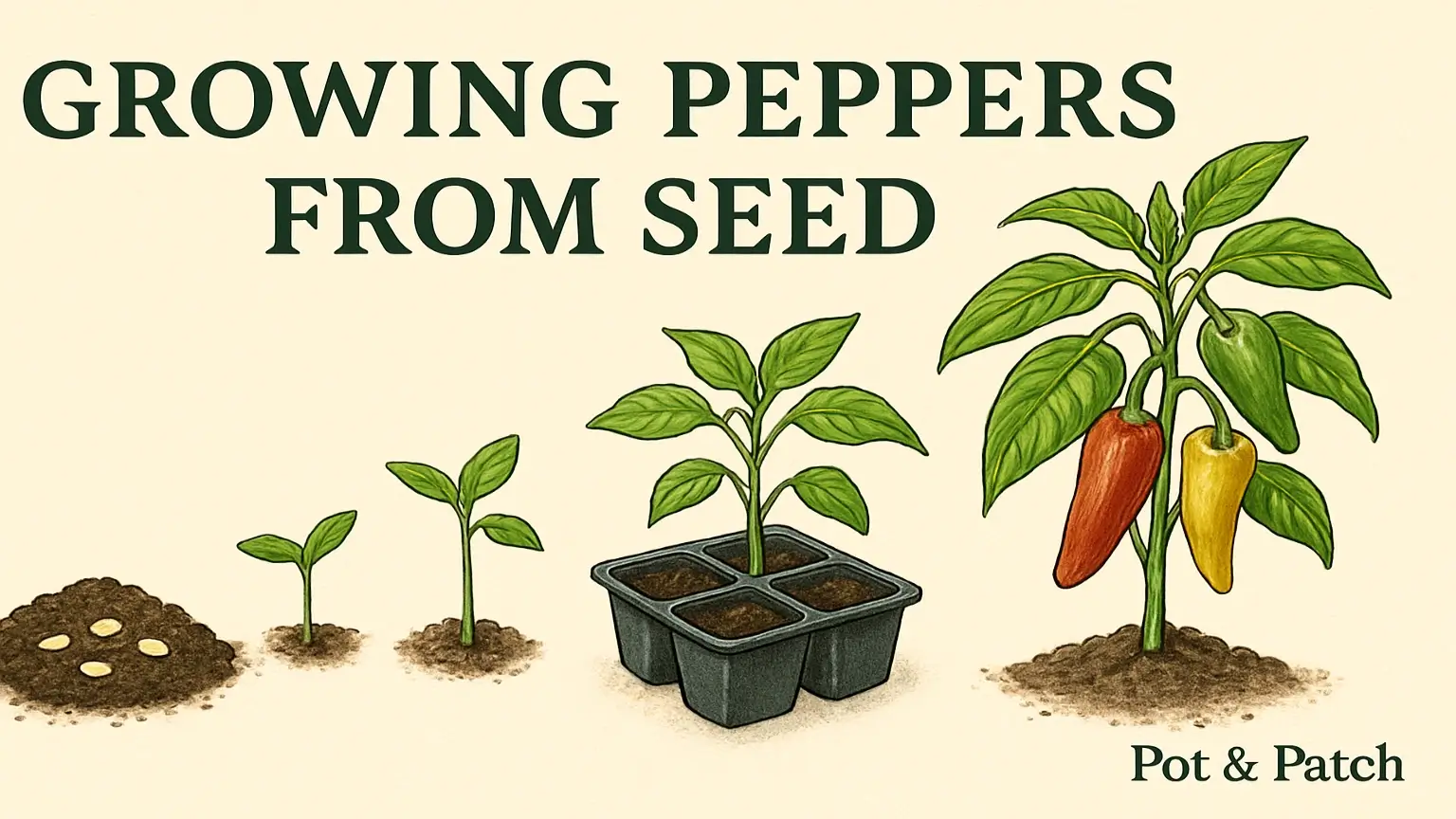
For most home gardeners, the easiest method is to start seeds indoors about 8 to 10 weeks before planting them outside. This guide covers everything from sowing the first seeds to preparing healthy pepper seedlings for transplanting.
When to Start Growing Peppers from Seed
The best time to start pepper seeds depends on your local weather and when the plants can safely move outdoors.
Peppers are warm-season crops that struggle in cold soil. In most parts of the United States, starting them indoors gives them a better chance to mature and produce fruit before the growing season ends.
A useful rule is to start pepper seeds 8 to 10 weeks before your planned outdoor transplanting date.
That date isn’t always the same as your last expected spring frost. You may need to wait longer for the soil to warm up.
How to Calculate Your Seed-Starting Date
First, find the average last spring frost date for your area. Then choose an expected transplanting date when frost danger has passed and the weather is reliably warm.
Count backward 8 to 10 weeks.
For example, if you expect to transplant peppers on May 15, a reasonable indoor sowing window would be approximately March 6 to March 20.
That is only an example. Your actual date should reflect local conditions.
| Growing situation | Seed-starting approach |
|---|---|
| Short northern growing season | Start indoors early enough to produce mature transplants |
| Moderate spring climate | Usually 8–10 weeks before transplanting |
| Long, warm growing season | Indoor starting is still useful, but timing may be more flexible |
| Slow-maturing hot pepper varieties | Some may benefit from starting earlier |
| Heated greenhouse or protected setup | Follow the planned planting date and available growing conditions |
Should Hot Peppers Be Started Earlier?
Some hot pepper varieties, especially habaneros and other slow-maturing types, can take longer to germinate and develop than common bell peppers.
Starting these varieties a little earlier may be helpful in regions with short summers.
However, don’t automatically start every hot pepper 12 weeks ahead. Check the seed packet and consider how much light and indoor growing space you have.
Seedlings started too early may become tall, crowded, or root-bound before outdoor temperatures are suitable.
What You Need to Start Pepper Seeds Indoors
You don’t need an expensive greenhouse or complicated equipment.
A small shelf, a seed tray, and a suitable grow light can be enough to raise several healthy pepper plants.
Essential Supplies
- Pepper seeds: Choose fresh seeds from a reliable supplier.
- Seed-starting trays or small pots: Use clean containers with drainage holes.
- Seed-starting mix: Choose a lightweight, well-draining growing medium.
- Watering tray or small watering can: Useful for keeping the mix evenly moist.
- Grow light: Helps seedlings develop sturdy stems indoors.
- Plant labels: Identify each variety and sowing date.
- Warm growing location: Important for successful germination.
A seedling heat mat and clear humidity dome can also be useful, but neither is essential in every setup.
Choosing the Right Pepper Seeds
Bell peppers, jalapeños, banana peppers, cayenne peppers, and serranos are all suitable for starting indoors.
If you’re a beginner, consider growing one sweet variety and one moderately hot variety. Choose peppers that match your climate and available growing space.
For example, gardeners with short summers may prefer early-maturing varieties, while gardeners with longer warm seasons can experiment with slower-growing peppers.
Look at the seed packet for days to maturity, plant size, and any special germination instructions.
What Is the Best Seed-Starting Mix for Peppers?
Choose a fresh, lightweight growing mix that holds moisture without staying waterlogged.
Many commercial seed-starting mixes contain ingredients such as coconut coir, peat moss, perlite, and vermiculite.
These materials help provide a balance of moisture and air around developing roots.
Avoid filling seed trays with ordinary backyard soil. Garden soil can compact in small containers and may introduce insects, weed seeds, or disease-causing organisms.
A fine-textured seed-starting mix is convenient, although a good-quality soilless potting mix can also work.
Growing Peppers from Seed: Step-by-Step Planting Instructions
Once your supplies are ready, planting pepper seeds is straightforward. The main things to get right are sowing depth, warmth, and moisture.
Step 1: Prepare the Seed-Starting Mix
Pour the growing mix into a bowl or bucket and add water gradually. Stir until the mix is evenly damp. It should feel like a wrung-out sponge rather than a dripping wet handful.
Fill your seed trays or small pots, leaving a little space below the rim. Gently level the surface without pressing the mix down firmly.
Pre-moistening helps prevent dry pockets that can make germination uneven.
Step 2: Plant Pepper Seeds ¼ Inch Deep
Make a small hole approximately ¼ inch deep in each seed-starting cell.

Place one fresh pepper seed in the hole and cover it lightly with growing mix.
If you’re using older seeds or seeds with uncertain viability, you can sow two per cell and remove the weaker seedling later. There’s no need to pack the soil tightly over the seeds.
Pepper seeds are small, and planting too deeply can make it harder for emerging seedlings to reach the surface. Label each tray with the variety and planting date.
Step 3: Keep the Growing Mix Warm
Pepper seeds germinate best in warm conditions.
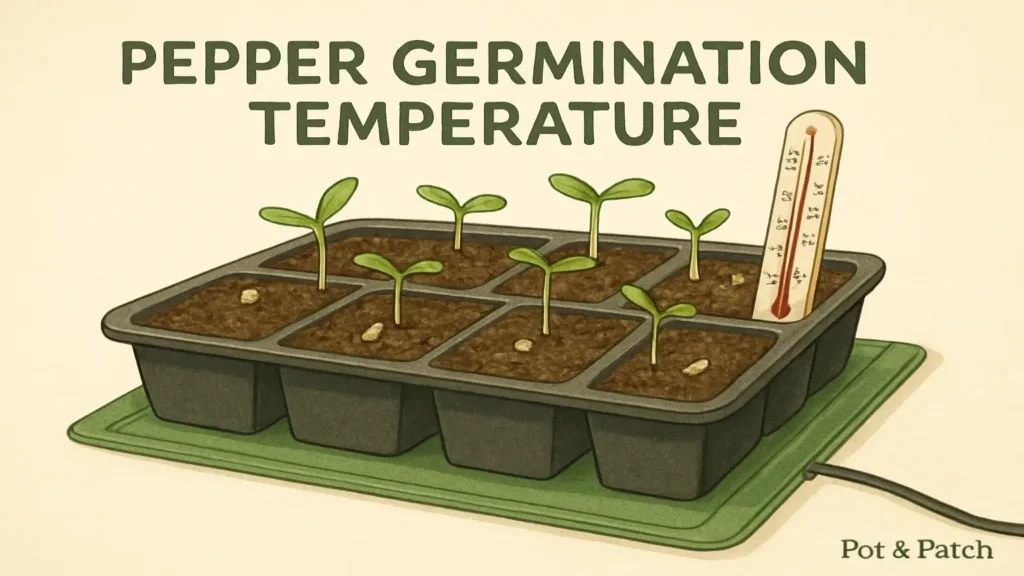
A growing-medium temperature around 80–85°F is a useful target. Temperatures approaching 90°F may also be suitable for some varieties, but avoid excessive heat.
A seedling heat mat with a thermostat can help maintain consistent warmth.
Remember that room temperature and soil temperature aren’t necessarily the same. A room at 70°F may have a seed tray that’s cooler, particularly near a window.
Check the temperature of the growing mix if your seeds are taking longer than expected to sprout.
Step 4: Maintain Consistent Moisture
Seeds must absorb water before germination can begin. Keep the growing mix evenly moist, but never saturated.
A gentle mist or bottom watering works well because it won’t disturb shallowly planted seeds.
For bottom watering, place the pots in a shallow tray of water and allow moisture to move upward through the drainage holes.
Remove excess water after the mix has absorbed enough.
A clear humidity dome can reduce evaporation before the seeds sprout. If you use one, monitor condensation and avoid trapping excess moisture.
Step 5: Remove the Cover When Seedlings Emerge
Watch for small green shoots breaking through the surface. As soon as seedlings emerge, remove the humidity dome and position the tray under a grow light.
If you used a heat mat for germination, you can usually remove it once the seedlings have emerged, provided the growing area remains comfortably warm.
Young seedlings need light immediately to avoid developing long, weak stems.
Step 6: Thin Extra Seedlings
If more than one seed germinated in a cell, keep the strongest plant. Wait until the seedlings are established enough to identify the healthier one, then cut the others at the soil surface using small scissors.
Pulling extra seedlings out can disturb the roots of the plant you want to keep. One sturdy plant per cell is generally easier to manage than several competing seedlings.
How Long Do Pepper Seeds Take to Germinate?
Under suitable conditions, many pepper seeds germinate in approximately 7 to 21 days. However, germination time varies with variety, seed age, moisture, and growing-medium temperature.
Some slow-growing hot peppers can take several weeks longer.
| Condition | What to expect |
|---|---|
| Warm mix around 80–85°F | Often faster, more uniform germination |
| Cooler mix around 65–70°F | Slower germination |
| Old or poorly stored seeds | Lower germination rates and possible delays |
| Consistently soggy mix | Increased risk of seed decay |
| Mix that dries out | Germination may stall or seeds may fail |
| Certain slow hot-pepper varieties | Germination may take several weeks |
These are general patterns, not guaranteed germination times. If your seeds haven’t sprouted after two weeks, check the temperature and moisture before assuming they’ve failed.
With slow varieties, it may be reasonable to allow four weeks or longer, provided the medium is healthy and the seeds haven’t rotted.
Do Pepper Seeds Need Light to Germinate?
Pepper seeds don’t require light to germinate when properly covered at the recommended depth. Warmth and moisture are more important during this stage.
After the first seedlings appear, however, strong light becomes essential. Don’t wait until every seed has germinated before giving the first sprouts adequate lighting.
How to Care for Pepper Seedlings After Germination
The first few weeks after germination are important because seedlings develop their initial leaves and root systems. At this stage, you want compact plants with healthy green leaves rather than tall, thin stems.
Give Seedlings Enough Light
Indoor pepper seedlings usually perform better under a grow light than on a windowsill alone. Provide approximately 14 to 16 hours of light daily, followed by a dark period.
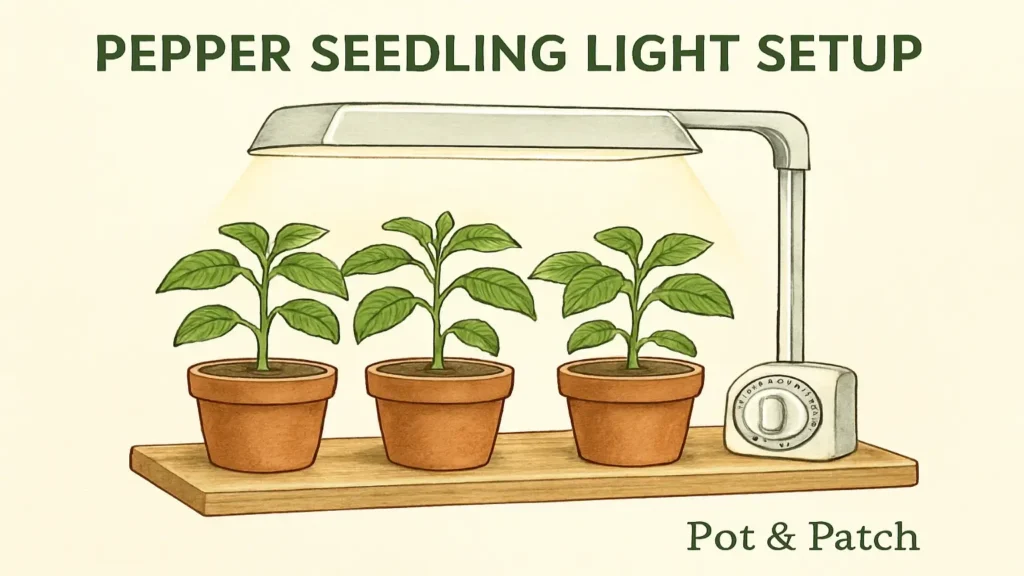
A simple timer makes this consistent.
Position your grow light according to the manufacturer’s recommendations. Many seed-starting LED fixtures work well just a few inches above the leaves, but the correct distance depends on brightness and fixture design.
Raise the light as the plants grow.
If seedlings begin leaning toward the light or developing long, weak stems, they may not be receiving enough illumination.
Water Without Soaking the Roots
Young pepper roots need both moisture and oxygen. Check the growing mix regularly and water when the surface begins to dry, before the root zone becomes completely dry. Avoid leaving seed trays standing in water for long periods.
Small containers can dry quickly under lights, but watering every day without checking the mix can lead to root problems.
A good habit is to lift a cell tray or pot and notice its weight. Containers become noticeably lighter as the mix dries.
Understand Seed Leaves and True Leaves
The first two leaves that appear after germination are called cotyledons, or seed leaves. They often look narrow and simple.
The next leaves that develop are the plant’s true leaves. These begin to resemble the foliage of a mature pepper plant. True leaves are a useful sign that the seedling is developing beyond its initial germination stage.
Once seedlings have true leaves, you can assess whether they need more space or supplemental nutrients.
When Should You Fertilize Pepper Seedlings?
Pepper seeds contain stored energy to support their earliest growth. Very young seedlings generally don’t need fertilizer immediately after sprouting.
Some seed-starting mixes contain little or no added fertilizer, while others include enough nutrients for several weeks. Check the growing-medium label before feeding.
If the seedlings have developed several true leaves and the mix contains little nutrition, a dilute, balanced, water-soluble fertilizer may be appropriate.
Follow the fertilizer label and avoid strong concentrations.
Overfeeding small seedlings can damage tender roots and slow their development.
When to Pot Up Pepper Seedlings
Pepper seedlings may need larger containers before they’re ready for the garden. You can begin considering potting up once the first true leaves develop, particularly if the roots are filling their cells.
Signs a seedling needs more room include roots emerging through drainage holes, rapid drying, and crowded foliage.
Move the seedling into a clean pot approximately 1 to 2 inches wider than its previous container. Lift it carefully by the root ball rather than pulling on the stem.
Fill the new container with suitable potting mix, position the seedling at approximately its previous growing depth, and water gently.
Continue providing strong light while the roots establish.
Pepper Seed Growth Timeline: From Sowing to Transplanting
Growing peppers from seed requires several stages of development. The exact schedule varies, but understanding the sequence makes it easier to plan.

| Growing stage | Approximate timing | What to do |
|---|---|---|
| Plan planting date | 8–10 weeks before transplant | Choose seeds and prepare supplies |
| Sow seeds | Day 1 | Plant about ¼ inch deep in moist mix |
| Germination | Often days 7–21 | Maintain warmth and consistent moisture |
| First seed leaves | Immediately after emergence | Remove cover and provide grow lights |
| First true leaves | Following weeks | Monitor light, moisture, and root development |
| Potting up | When cells become crowded | Transfer into larger pots if needed |
| Hardening off | Final 7–14 days before planting | Gradually introduce outdoor conditions |
| Outdoor transplant | When weather and soil are warm | Plant in containers, beds, or garden soil |
This is a planning timeline, not a guarantee that every seedling will reach the same stage on the same day. A cool seed-starting setup, slower-growing variety, or delayed spring can extend the schedule.
Healthy plants are more important than matching a fixed calendar.
Common Pepper Seed Germination and Seedling Problems
Most indoor seed-starting problems involve temperature, moisture, light, or growing-medium conditions.

Before applying fertilizer or other treatments, look for the most likely cause.
| Problem | Possible cause | What to do |
|---|---|---|
| Pepper seeds not germinating | Cool mix, old seeds, poor moisture | Check temperature and seed viability |
| Seedlings are tall and thin | Insufficient light | Improve lighting and adjust fixture distance |
| Yellow seedling leaves | Overwatering, nutrient problems, root stress | Inspect moisture, drainage, and growth |
| Seedlings falling over | Possible damping off | Remove affected seedlings and improve sanitation |
| Seedlings growing very slowly | Low temperature, poor light, crowded roots | Check growing conditions |
| Mold on mix surface | Excess moisture and limited airflow | Reduce saturation and improve ventilation |
| Leaves curling or looking stressed | Environmental stress or pests | Inspect leaves, roots, and growing conditions |
Why Aren’t My Pepper Seeds Germinating?
The first thing to check is temperature. Pepper seeds may germinate very slowly when the growing medium is too cool.
Next, examine moisture. Mix that is either constantly soaked or allowed to dry completely can interfere with germination. Seed age also matters. Old seeds or seeds stored in warm, humid conditions may have reduced viability.
If only a few cells germinate, the issue may be uneven moisture or variation in seed quality.
Why Are My Pepper Seedlings Leggy?
Leggy seedlings have long, thin stems and often lean toward the nearest light source. The most common cause is inadequate light.
Move seedlings under a suitable grow light, ensure the light reaches all the plants evenly, and maintain the recommended lighting schedule.
Gentle airflow can also help seedlings develop sturdier stems, but it cannot replace sufficient light.
Why Are My Pepper Seedlings Turning Yellow?
Yellow leaves have several possible causes. Overwatering is common, especially when seedlings grow in trays without adequate drainage.
Check whether the roots have access to air and whether excess water is collecting beneath the containers.
Older cotyledons may naturally yellow as the plant grows, but yellowing true leaves deserve closer attention.
If moisture, light, and temperature are appropriate, consider whether the growing medium has enough nutrients.
What Is Damping Off?
Damping off is a disease problem that can affect seeds and very young seedlings. Affected plants may develop a thin, dark, weakened stem near the soil surface and suddenly collapse.
Several soilborne pathogens can cause it, including Pythium and Rhizoctonia.
To reduce the risk:
- Use clean seed trays and fresh growing medium.
- Avoid constantly soggy conditions.
- Provide drainage and gentle airflow.
- Keep seedlings in suitable growing temperatures.
- Remove collapsed, infected seedlings promptly.
Plants that have already collapsed from damping off rarely recover. Prevention is much more effective than attempting to rescue severely affected seedlings.
When to Move Pepper Seedlings Outdoors
Your seedlings are ready for the next stage when they’re healthy, have several true leaves, and have developed enough roots to hold their growing mix together.
However, plant size alone doesn’t determine transplanting time. Outdoor conditions must also be suitable.
Check the Weather and Soil Temperature
Wait until the danger of frost has passed. Nighttime temperatures should generally remain above 50°F, with warmer conditions preferable.
Pepper roots establish better in warm soil. Around 65°F is a useful transplanting target. Planting into cold soil can delay growth even when the seedlings look healthy.
Harden Off Pepper Seedlings
Indoor seedlings aren’t accustomed to strong sunlight, wind, and fluctuating outdoor temperatures. Hardening off gradually prepares them for those conditions. Begin approximately 7 to 14 days before transplanting.

On the first day, place the seedlings outdoors for a short period in a sheltered, shaded location. Over the following days, gradually increase their outdoor exposure and introduce more direct sunlight. Bring the plants indoors if temperatures become too low or the weather turns harsh.
By the end of the process, the seedlings should be able to tolerate normal outdoor conditions for their growing location.
Transplant Without Damaging Roots
Choose a mild, cloudy day or late afternoon for transplanting. Water the seedlings before removing them from their pots.
Handle each plant by its root ball and avoid damaging the main stem. After planting, water thoroughly to settle the soil around the roots. From here, the growing method depends on where you want to raise your plants.
If you’re gardening on a balcony or patio, see our guide to growing peppers in containers for pot selection, watering, and mature plant care. For additional pepper-growing topics, visit the Pot & Patch Peppers guide.
Frequently Asked Questions
How Many Pepper Seeds Should I Plant Per Hole?
One fresh seed per cell is usually sufficient when you have good-quality seeds. If seeds are old or their germination rate is uncertain, sow two or three and thin the extras once seedlings are established.
Should I Soak Pepper Seeds Before Planting?
Soaking is optional, not a requirement. Fresh, viable pepper seeds can germinate successfully when planted directly into warm, moist seed-starting mix. Consistent temperature and moisture are generally more important than soaking treatments.
Can You Grow Peppers from Store-Bought Pepper Seeds?
Seeds from fully ripe store-bought peppers may germinate if they’re viable. However, peppers sold in grocery stores may be hybrids, so plants grown from their seeds might not produce identical fruit.
For predictable results, use seeds labeled with a known variety.
Can You Plant Pepper Seeds Directly in the Ground?
Yes, in climates with long, consistently warm growing seasons. In much of the United States, starting indoors is more dependable because outdoor soil may remain too cool for successful early germination.
How Long Does It Take to Grow Peppers from Seed to Harvest?
The entire process often takes several months. Peppers generally need around 8 to 10 weeks indoors before transplanting, followed by additional time outdoors to grow, flower, and ripen fruit.
The total varies considerably by variety, weather, and growing conditions. Days to maturity on many pepper seed packets are measured from transplanting, not from the original sowing date.
Do Pepper Seeds Need a Heat Mat?
Not always. A heat mat is particularly helpful if the seed-starting location is cool. If the growing mix already stays consistently warm, additional bottom heat may be unnecessary.
What Do Pepper Seedlings Look Like?
Newly emerged pepper seedlings usually have two narrow seed leaves. As they develop, broader true leaves appear above them. Healthy seedlings should gradually become sturdy, upright plants with green foliage.
Final Thoughts
Growing peppers from seed is easier when you focus on a few essentials: warm germination conditions, shallow planting depth, even moisture, and plenty of light after sprouting.
Start at the right time for your local climate, give seedlings more room as they develop, and don’t rush them outdoors before the soil warms.
Whether you’re planning to grow bell peppers in pots or hot peppers in a small backyard garden, strong seedlings give your plants a better start for the season ahead.